

System Overview#
EnvironmentGenerationAgent turns a natural-language task description and
Arena’s live registries into a validated ArenaEnvGraphSpec.
For more details on the Env Spec, see
Environment Definition.
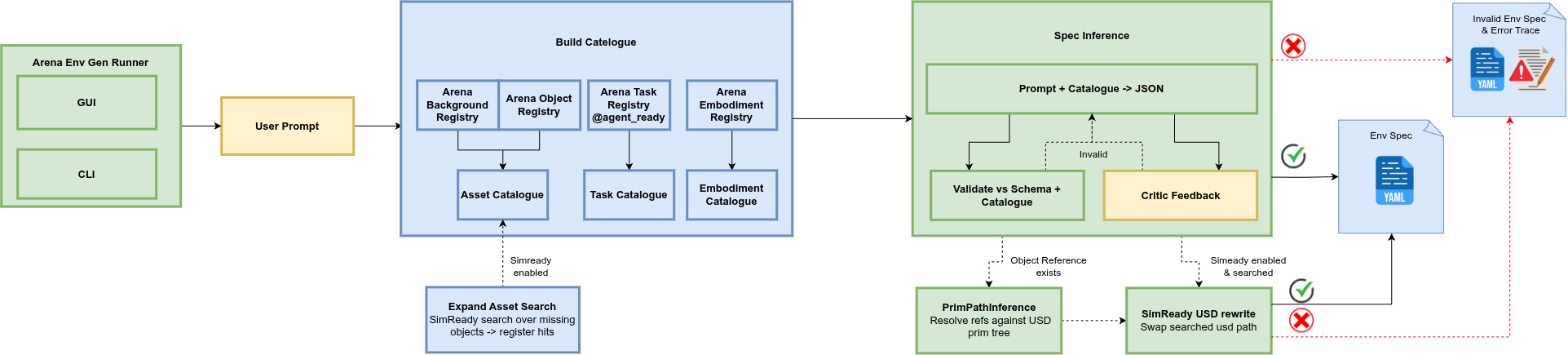
From a GUI or CLI launcher of the environment generation agent, given the user prompt, the agent builds asset, task, and embodiment
catalogs (optionally expanding assets via SimReady), infers a JSON Env Spec in the strict ArenaEnvGraphSpec schema, with schema and catalog validation plus critic retries.
Retries are triggered by the critic feedback from the spec inference call.
Then optionally resolves prim paths and rewrites searched SimReady USD paths, returning a valid Env Spec or an invalid spec with an error trace.#
Catalog inputs#
Each generate_spec() call starts from catalogs the caller passes in, or
builds them from the live registries:
AssetCatalogue— embodiments, backgrounds, and objects fromAssetRegistryRelationCatalogue— relations marked@agent_readyfromObjectRelationLibraryRegistryTaskCatalogue— tasks marked@agent_readyfromTaskRegistry
Catalogs are serialized into the model prompt and never written to disk. Spec inference uses them as vocabulary and as the validation surface. Prim-path inference does not; it reads the selected background’s USD prim tree instead.
How generation runs#
generate_spec() runs four stages after the catalogs are ready:
Optional SimReady asset search. When
enable_simready_searchis on,MissingObjectInferencecompares the prompt againstAssetCatalogue.objectsand returns search phrases for missing items. SimReady returns USD candidates (and unmatched phrases). Hits are registered dynamically and appended to the asset catalog—so the vocabulary fed to inference grows. Task and relation catalogs are unchanged. The agent keeps a map from each temporary registry name to its USD path for the rewrite step later.Spec inference with critic retries.
SpecInferencetakes the prompt plus the asset, relation, and task catalog strings. The model returns JSON under the ArenaEnvGraphSpec schema. Arena validates that JSON with Pydantic and cross-checks it against the catalogs.On validation failure, the rejected response and errors go back as critic feedback and the model regenerates the full spec—at most three critic-loop iterations (
MAX_SPEC_INFERENCE_CALLS). Each of those iterations still goes through the inference backend’s transport retries (defaultmax_retries=3, so up to four attempts per iteration for network, empty-response, or malformed-JSON failures). On success, the spec may still carry object references withoutprim_pathvalues.Optional prim-path resolution. If the spec has
object_references,PrimPathInferenceloads the background USD prim tree, resolves those references in one structured-output call (with the same transport retries), checks every path against the tree, and merges the result into the spec. Specs without object references skip this stage. There is no critic loop here.SimReady USD rewrite (when needed). If any objects came from SimReady search, their temporary registry names are rewritten to the portable
simready_usd_objectentry, with the searched path stored inparams["usd_path"]. No model call. If nothing was searched, this step is a no-op.
What generate_spec() returns#
Success:
(ArenaEnvGraphSpec, None). See Environment Definition for the spec. Review it in the GUI runner, or save it as YAML and reuse it without another model call.Failure:
(None, data), wheredatais the rejected JSON or unresolved spec dict.agent.tracesholds schema, catalog, prim-path, or rewrite errors.agent.unavailable_objectslists SimReady search phrases that found no candidate.
After a successful return, ArenaEnvGraphSpec.to_arena_env() turns the
Env Spec into Arena scene,
embodiment, and task objects. ArenaEnvBuilder then runs the
relation solver, placement validation, and
environment compilation. See Environment Builder for that
post-agent pipeline.