

Policy Training#
Docker Container: Base (see Installation for more details)
./docker/run_docker.sh
Training Command#
Training uses Arena’s bridge to Isaac Lab’s unified training script. The --external_callback
argument points to an Arena function that reads the --task argument, builds the environment,
and registers it with gym before training starts.
python isaaclab_arena/scripts/train.py \
  --rl_library rsl_rl \
  --external_callback isaaclab_arena.environments.isaaclab_interop.environment_registration_callback \
  --task lift_object \
  --rl_training_mode \
  --num_envs 4096 \
  --max_iterations 2000
Tip
Add --viz kit to open the GUI and watch training live.
Checkpoints are written to logs/rsl_rl/generic_experiment/<timestamp>/.
The agent configuration is saved alongside as params/agent.yaml,
which the evaluation script uses to reconstruct the policy at inference time.
Overriding Hyperparameters#
Hyperparameters come from RLPolicyCfg in isaaclab_arena_examples/policy/base_rsl_rl_policy.py
and can be overridden with Hydra syntax appended to the training command:
# Change network activation function to relu (default: elu)
agent.policy.activation=relu

# Adjust the learning rate (default: 0.0001)
agent.algorithm.learning_rate=0.001

# Save a checkpoint more frequently (default: every 200 iterations)
agent.save_interval=500
For example, to train with relu activation and a higher learning rate:
python isaaclab_arena/scripts/train.py \
  --rl_library rsl_rl \
  --external_callback isaaclab_arena.environments.isaaclab_interop.environment_registration_callback \
  --task lift_object \
  --rl_training_mode \
  --num_envs 4096 \
  --max_iterations 2000 \
  agent.policy.activation=relu \
  agent.algorithm.learning_rate=0.001
Resuming from a Checkpoint#
To resume training from a previously saved checkpoint, use the --resume flag
together with --load_run (run folder name) and --checkpoint (model filename).
Both arguments are optional — when omitted, the most recent run and latest checkpoint
are used automatically.
python isaaclab_arena/scripts/train.py \
  --rl_library rsl_rl \
  --external_callback isaaclab_arena.environments.isaaclab_interop.environment_registration_callback \
  --task lift_object \
  --rl_training_mode \
  --num_envs 4096 \
  --max_iterations 4000 \
  --resume \
  --load_run <timestamp> \
  --checkpoint model_1999.pt
Replace <timestamp> with the run folder name under logs/rsl_rl/generic_experiment/.
If --load_run is omitted, the latest run is selected. If --checkpoint is omitted,
the latest checkpoint in that run is loaded.
Monitoring Training#
Launch Tensorboard to monitor progress:
python -m tensorboard.main --logdir logs/rsl_rl
Each training iteration prints a summary to the console. This example is from a
short run with --max_iterations 20; the initial training command uses 2000 iterations.
Timings and metric values vary with hardware, configuration, and random seed.
Learning iteration 3/20

                            Total steps: 393216
                       Steps per second: 20255
                        Collection time: 4.799s
                          Learning time: 0.054s
                        Mean value loss: 0.0028
                    Mean surrogate loss: -0.0017
                      Mean entropy loss: 11.5071
                            Mean reward: 0.75
                    Mean episode length: 92.78
                        Mean action std: 1.02
               Episode_Reward/joint_vel: -0.0009
     Metrics/object_pose/position_error: 0.2268
          Episode_Reward/lifting_object: 0.1200
    Episode_Reward/object_goal_tracking: 0.0259
  Metrics/object_pose/orientation_error: 3.0806
             Episode_Reward/action_rate: -0.0005
Episode_Reward/object_goal_tracking_fine_grained: 0.0000
     Episode_Termination/object_dropped: 0.0000
           Episode_Termination/time_out: 0.3371
            Episode_Termination/success: 0.0000
         Episode_Reward/reaching_object: 0.0039
--------------------------------------------------------------------------------
                         Iteration time: 4.85s
                           Time elapsed: 0:00:19
                                    ETA: 0:01:19
Multi-GPU Training#
Add --distributed to spread environments across all available GPUs:
python isaaclab_arena/scripts/train.py \
  --rl_library rsl_rl \
  --external_callback isaaclab_arena.environments.isaaclab_interop.environment_registration_callback \
  --task lift_object \
  --rl_training_mode \
  --num_envs 4096 \
  --max_iterations 2000 \
  --distributed
Expected Results#
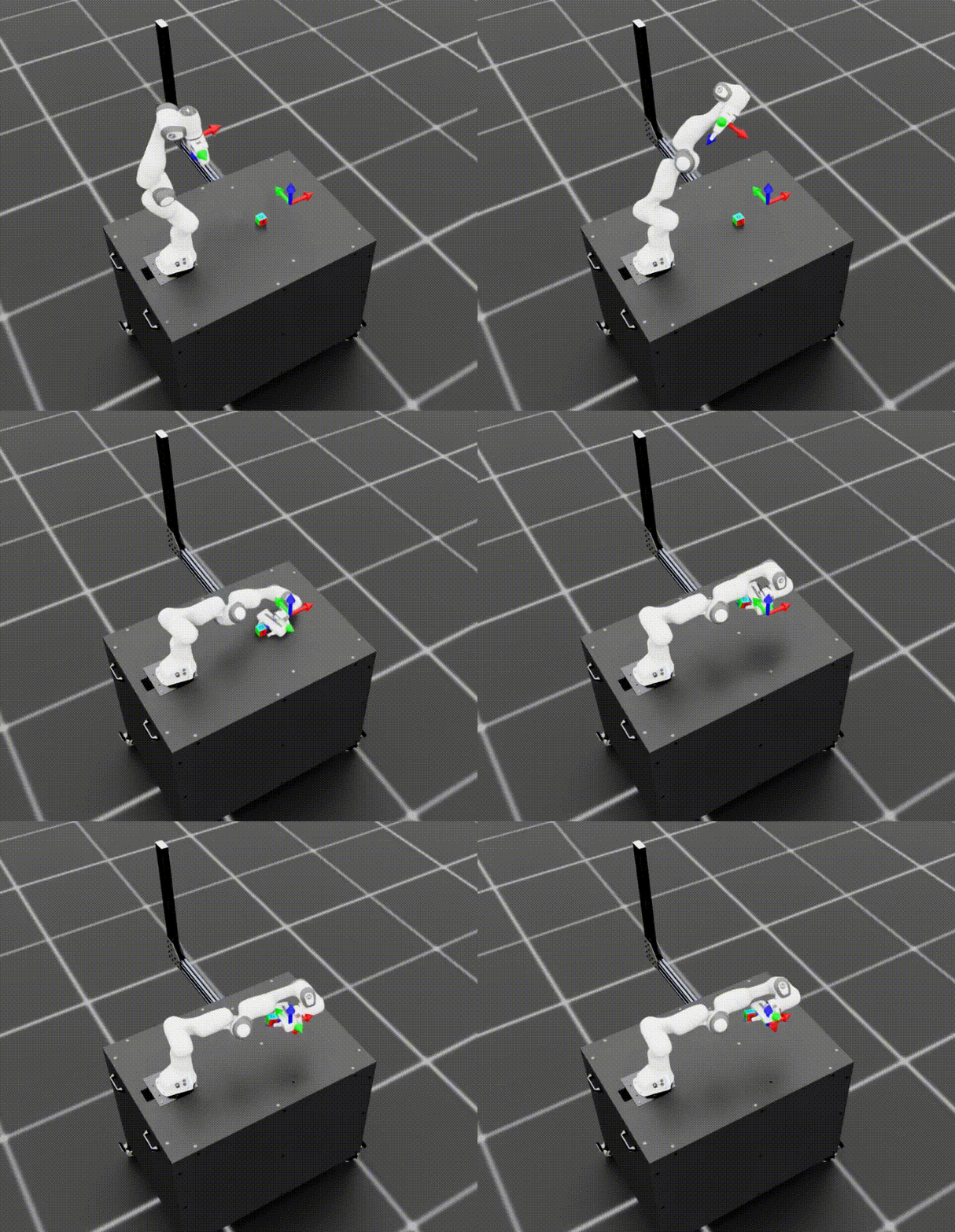
After 2,000 iterations (~40 minutes on a single GPU with 4096 environments), the trained policy should reliably grasp and lift objects to commanded target positions.
Note
Training performance depends on hardware, environment configuration, and random seed. For best results, use a powerful GPU (e.g., RTX 4090, A100, L40).