

Object Control Runner#
The Object Control Runner checks whether an authored environment can satisfy its task predicates without requiring a robot policy. A JSONL recipe gives pose and joint-position targets. The runner drives existing scene objects toward those targets with bounded forces instead of teleporting them, then reports whether the task completed.
Use move and lift for object-pose targets, joint for articulation targets, and
release to stop controlling an object pose. wait advances simulation, while mark,
check, and wait_final record and validate task progress. inspect prints the current
state, and finish ends a live command stream. A setup_joint record must appear before
runtime commands when an articulation needs an effort-controlled actuator.
The demo always overrides the environment to 120 Hz physics and control (sim.dt = 1/120,
decimation = 1) before construction. Each env.step() advances exactly one physics tick,
so movement targets and explicit step budgets use the same clock. Episode timeouts remain in
seconds. Consecutive-step success requirements and tracked events are rescaled to preserve their
original minimum hold durations, rounded up to a 120 Hz tick. Other predicates are evaluated at
the new control rate. Lab records every eighth step for 15 FPS video, including progress overlays.
Results#
Viewport recording is enabled by default and requires the Kit visualizer. Each run writes its
artifacts under --output:
validation.jsoncontains the final pass/fail result, task state, poses, joints, and events.demo.mp4is the recorded viewport with task-progress annotations.progress.jsonand boundary images and state files record subtask transitions.A failed run writes
failure_<reason>_...jsondiagnostics and, when available, a viewport PNG.timings.jsonreports simulator startup and nested wall-clock timers for scene preparation, loading, reset, recipe commands, reporting, video postprocessing, and environment cleanup. Parent timers include their children; do not sum both when computing total runtime.
Pass --no_record --visualizer none for a headless run without viewport artifacts.
Open a cabinet#
Run the checked-in cabinet recipe inside the Arena container:
isaaclab.sh -p isaaclab_arena/agentic_tools/object_control_runner.py \
  --env_spec isaaclab_arena_environments/kitchen_bench/kitchen_bench_lightwheel_open_cabinet_u_shaped_with_island_farmhouse2.yaml \
  --commands isaaclab_arena_environments/kitchen_bench/kitchen_bench_lightwheel_open_cabinet_u_shaped_with_island_farmhouse2_object_control.jsonl \
  --output artifacts/object_control/open_cabinet \
  --placement_seed 42 \
  --visualizer kit
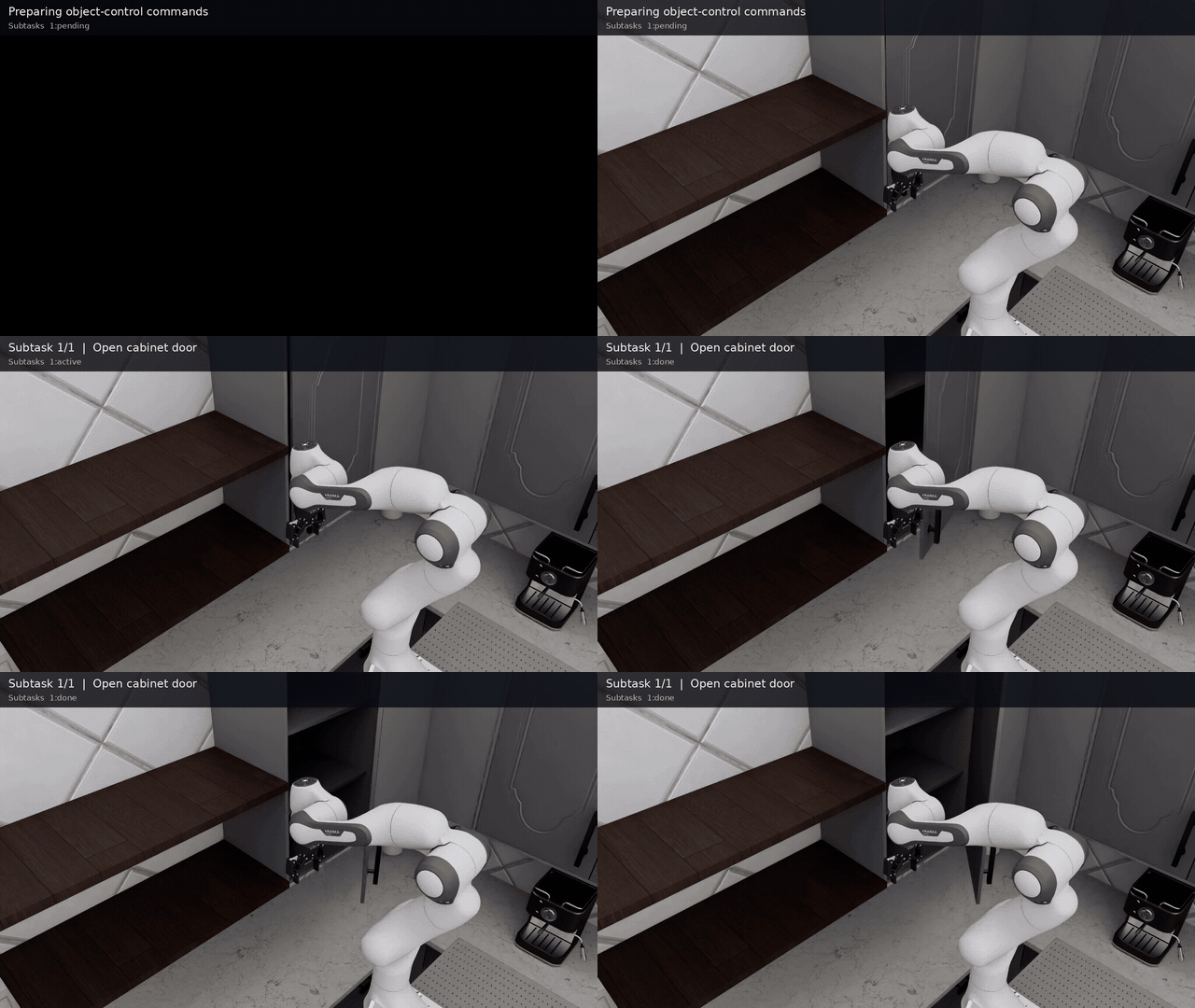
Recipe:
{"action":"setup_joint","name":"cabinet","joint_name":"left_door_joint","effort_limit":100.0,"replace_existing":true}
{"action":"mark","index":0,"boundary":"start","title":"Open cabinet door"}
{"action":"joint","name":"cabinet","joint_name":"left_door_joint","normalized_goal":0.5,"seconds":3.0,"gain":100.0,"damping":15.0,"limit":50.0}
{"action":"check","index":0}
{"action":"mark","index":0,"boundary":"end","title":"Open cabinet door"}
{"action":"wait_final"}
{"action":"finish"}
Place bananas in a bowl#
The recipe gives both bananas a consistent orientation and separate landing positions, then releases them above the bowl interior. It runs against the benchmark scene without changing its task predicates or thresholds.
Run the checked-in banana-placement recipe:
isaaclab.sh -p isaaclab_arena/agentic_tools/object_control_runner.py \
  --env_spec isaaclab_arena_environments/kitchen_bench/kitchen_bench_lightwheel_place_bananas_in_wooden_bowl_u_shaped_with_island_farmhouse2.yaml \
  --commands isaaclab_arena_environments/kitchen_bench/kitchen_bench_lightwheel_place_bananas_in_wooden_bowl_u_shaped_with_island_farmhouse2_object_control.jsonl \
  --output artifacts/object_control/place_bananas \
  --placement_seed 42 \
  --visualizer kit
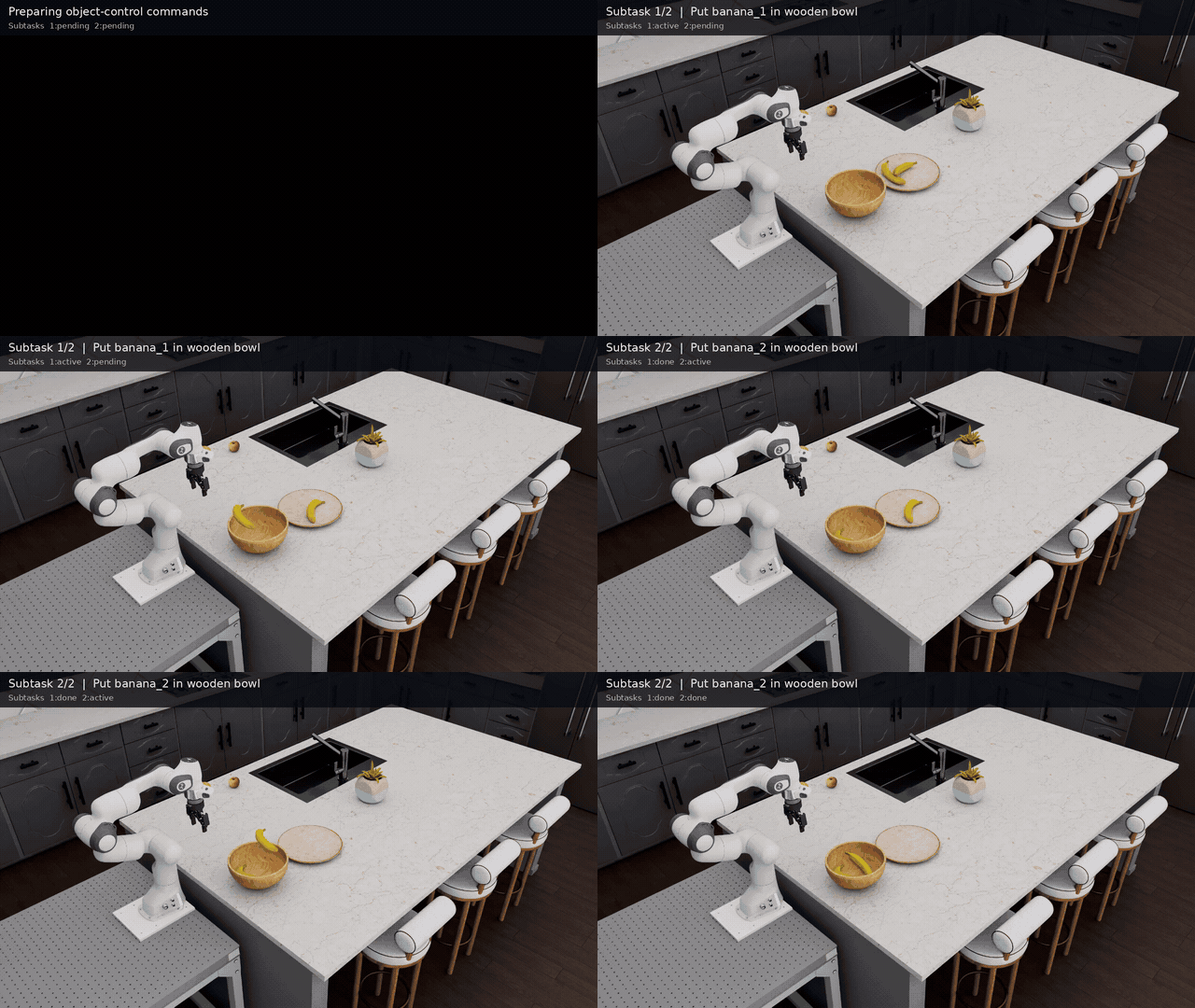
Recipe:
{"action":"wait","steps":360}
{"action":"mark","index":0,"boundary":"start","title":"Put banana_1 in wooden bowl"}
{"action":"move","name":"banana_1","reference":"banana_1","offset":[0.0,0.0,0.25],"seconds":2.0,"minimum_stiffness":40.0,"critical_damping":true}
{"action":"move","name":"banana_1","reference":"wooden_bowl","offset":[-0.065,0.0,0.2],"seconds":3.0,"minimum_stiffness":40.0,"critical_damping":true,"orientation":[0.0,0.0,0.0,1.0]}
{"action":"move","name":"banana_1","reference":"wooden_bowl","offset":[-0.065,0.0,0.1],"seconds":2.0,"minimum_stiffness":40.0,"critical_damping":true,"orientation":[0.0,0.0,0.0,1.0]}
{"action":"release","name":"banana_1"}
{"action":"wait","steps":240}
{"action":"check","index":0,"timeout_steps":600}
{"action":"mark","index":0,"boundary":"end","title":"Put banana_1 in wooden bowl"}
{"action":"mark","index":1,"boundary":"start","title":"Put banana_2 in wooden bowl"}
{"action":"move","name":"banana_2","reference":"banana_2","offset":[0.0,0.0,0.25],"seconds":2.0,"minimum_stiffness":40.0,"critical_damping":true}
{"action":"move","name":"banana_2","reference":"wooden_bowl","offset":[0.065,0.0,0.2],"seconds":3.0,"minimum_stiffness":40.0,"critical_damping":true,"orientation":[0.0,0.0,0.0,1.0]}
{"action":"move","name":"banana_2","reference":"wooden_bowl","offset":[0.065,0.0,0.1],"seconds":2.0,"minimum_stiffness":40.0,"critical_damping":true,"orientation":[0.0,0.0,0.0,1.0]}
{"action":"release","name":"banana_2"}
{"action":"wait","steps":240}
{"action":"check","index":1,"timeout_steps":600}
{"action":"mark","index":1,"boundary":"end","title":"Put banana_2 in wooden bowl"}
{"action":"wait_final"}
{"action":"finish"}
Live command stream#
Create a JSONL file containing any required setup_joint records, then start the runner with
--follow_commands. Append newline-terminated runtime commands from another process. The runner
waits for complete lines and exits when it receives {"action":"finish"}. See the
runner source
for the complete command and output reference.