



Inertial Measurement Unit (IMU)#
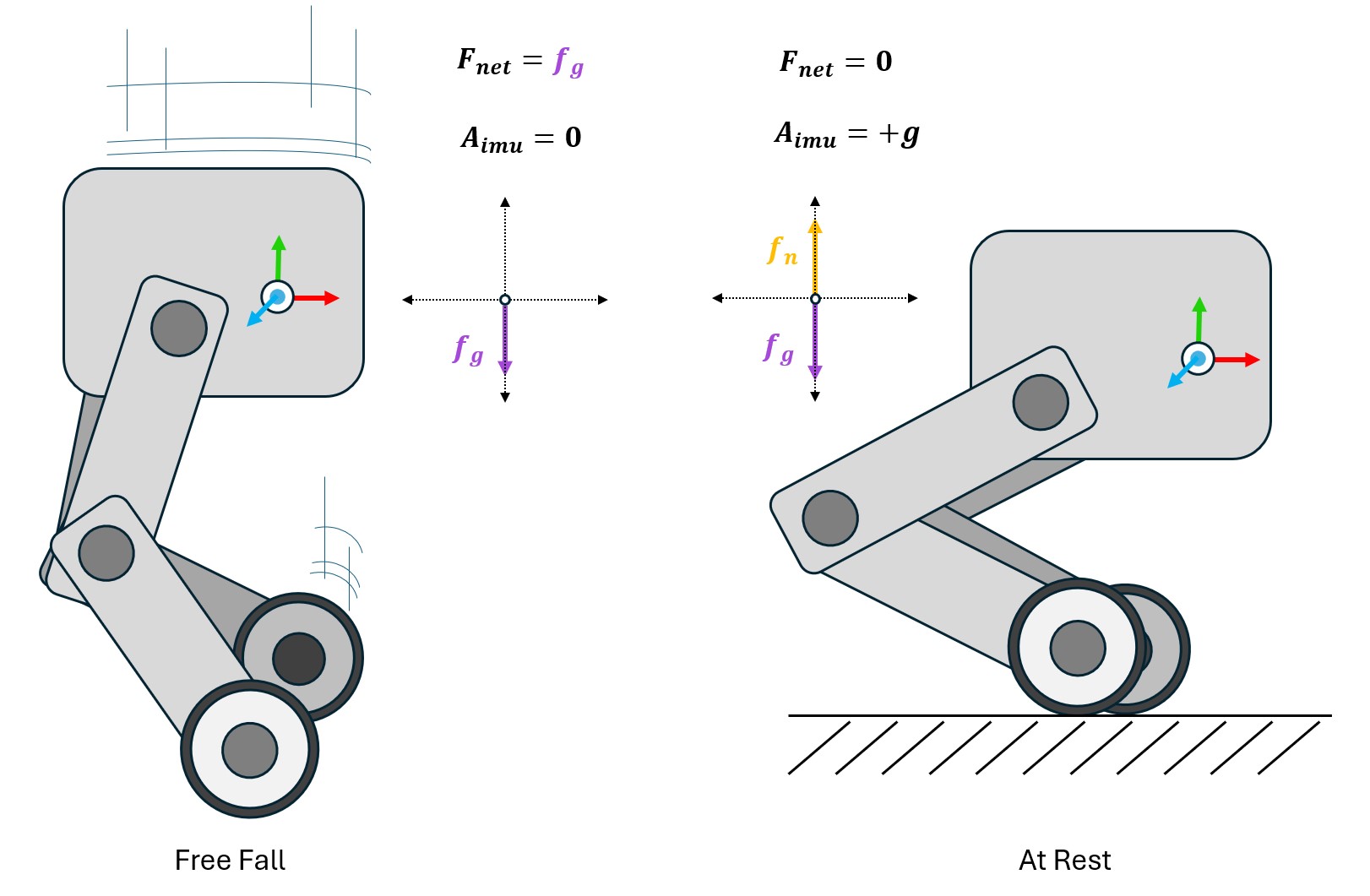
Inertial Measurement Units (IMUs) are a type of sensor for measuring the acceleration of an object. These sensors are traditionally designed report linear accelerations and angular velocities, and function on similar principles to that of a digital scale: They report accelerations derived from net force acting on the sensor.
A naive implementation of an IMU would report a negative acceleration due to gravity while the sensor is at rest in some local gravitational field. This is not generally needed for most practical applications, and so most real IMU sensors often include a gravity bias and assume that the device is operating on the surface of the Earth. The IMU we provide in Isaac Lab includes a similar bias term, which defaults to +g. This means that if you add an IMU to your simulation, and do not change this bias term, you will detect an acceleration of \(+ 9.81 m/s^{2}\) anti-parallel to gravity acceleration.
Consider a simple environment with an Anymal Quadruped equipped with an IMU on each of its two front feet.
from isaaclab.sensors import ImuCfg
from isaaclab.utils.configclass import configclass

##
# Pre-defined configs
##
from isaaclab_assets.robots.anymal import ANYMAL_C_CFG  # isort: skip


@configclass
class ImuSensorSceneCfg(InteractiveSceneCfg):
    """Design the scene with IMU sensors on the robot."""

    # ground plane
    ground = AssetBaseCfg(prim_path="/World/defaultGroundPlane", spawn=sim_utils.GroundPlaneCfg())

    # lights
    dome_light = AssetBaseCfg(
        prim_path="/World/Light", spawn=sim_utils.DomeLightCfg(intensity=3000.0, color=(0.75, 0.75, 0.75))
    )

    # robot
    robot = ANYMAL_C_CFG.replace(prim_path="{ENV_REGEX_NS}/Robot")

    imu_RF = ImuCfg(prim_path="{ENV_REGEX_NS}/Robot/LF_FOOT")
Here we have explicitly removed the bias from one of the sensors, and we can see how this affects the reported values by visualizing the sensor when we run the sample script
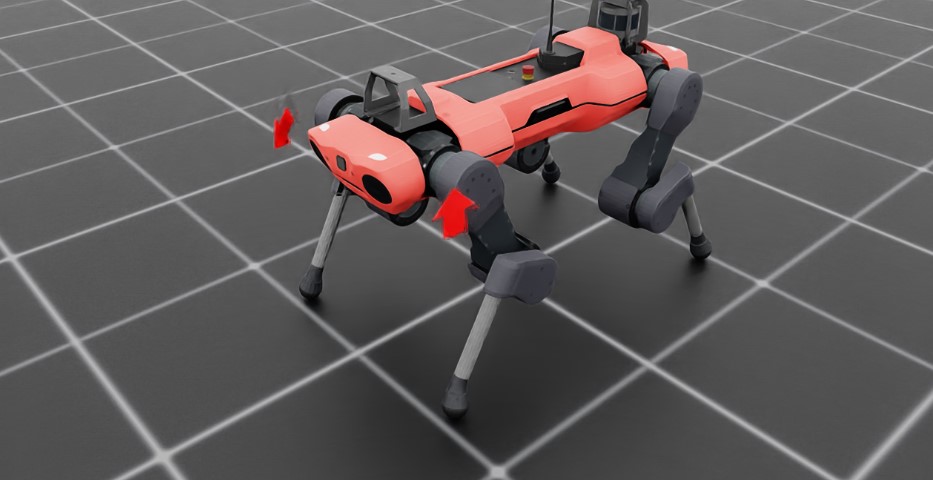
Notice that the right front foot explicitly has a bias of (0,0,0). In the visualization, you should see that the arrow indicating the acceleration from the right IMU rapidly changes over time, while the arrow visualizing the left IMU points constantly along the vertical axis.
Retrieving values from the sensor is done in the usual way
def run_simulator(sim: sim_utils.SimulationContext, scene: InteractiveScene):
  .
  .
  .
  # Simulate physics
  while simulation_app.is_running():
    .
    .
    .
    # print information from the sensors
    print("-------------------------------")
    print(scene["imu_LF"])
    print("Received linear velocity: ", scene["imu_LF"].data.lin_vel_b)
    print("Received angular velocity: ", scene["imu_LF"].data.ang_vel_b)
    print("Received linear acceleration: ", scene["imu_LF"].data.lin_acc_b)
    print("Received angular acceleration: ", scene["imu_LF"].data.ang_acc_b)
    print("-------------------------------")
    print(scene["imu_RF"])
    print("Received linear velocity: ", scene["imu_RF"].data.lin_vel_b)
    print("Received angular velocity: ", scene["imu_RF"].data.ang_vel_b)
    print("Received linear acceleration: ", scene["imu_RF"].data.lin_acc_b)
    print("Received angular acceleration: ", scene["imu_RF"].data.ang_acc_b)
The oscillations in the values reported by the sensor are a direct result of how the sensor calculates the acceleration, which is through a finite difference approximation between adjacent ground truth velocity values as reported by the sim. We can see this in the reported result (pay attention to the linear acceleration) because the acceleration from the right foot is small, but explicitly zero.
Imu sensor @ '/World/envs/env_.*/Robot/LF_FOOT':
        view type         : <class 'omni.physics.tensors.api.RigidBodyView'>
        update period (s) : 0.0
        number of sensors : 1

Received linear velocity:  tensor([[ 0.0203, -0.0054,  0.0380]], device='cuda:0')
Received angular velocity:  tensor([[-0.0104, -0.1189,  0.0080]], device='cuda:0')
Received linear acceleration:  tensor([[ 4.8344, -0.0205,  8.5305]], device='cuda:0')
Received angular acceleration:  tensor([[-0.0389, -0.0262, -0.0045]], device='cuda:0')
-------------------------------
Imu sensor @ '/World/envs/env_.*/Robot/RF_FOOT':
        view type         : <class 'omni.physics.tensors.api.RigidBodyView'>
        update period (s) : 0.0
        number of sensors : 1

Received linear velocity:  tensor([[0.0244, 0.0077, 0.0431]], device='cuda:0')
Received angular velocity:  tensor([[ 0.0122, -0.1360, -0.0042]], device='cuda:0')
Received linear acceleration:  tensor([[-0.0018,  0.0010, -0.0032]], device='cuda:0')
Received angular acceleration:  tensor([[-0.0373, -0.0050, -0.0053]], device='cuda:0')
-------------------------------
Code for imu_sensor.py
  1# Copyright (c) 2022-2026, The Isaac Lab Project Developers (https://github.com/isaac-sim/IsaacLab/blob/main/CONTRIBUTORS.md).
  2# All rights reserved.
  3#
  4# SPDX-License-Identifier: BSD-3-Clause
  5
  6"""Launch Isaac Sim Simulator first."""
  7
  8import argparse
  9
 10from isaaclab.app import AppLauncher
 11
 12# add argparse arguments
 13parser = argparse.ArgumentParser(description="Example on using the IMU sensor.")
 14parser.add_argument("--num_envs", type=int, default=1, help="Number of environments to spawn.")
 15parser.add_argument(
 16    "--physics",
 17    default="isaacsim_physx",
 18    choices=["isaacsim_physx"],
 19    help="Physics backend.",
 20)
 21# append AppLauncher cli args
 22AppLauncher.add_app_launcher_args(parser)
 23# demos should open Kit visualizer by default
 24parser.set_defaults(visualizer=["kit"])
 25# parse the arguments
 26args_cli = parser.parse_args()
 27
 28# launch omniverse app
 29app_launcher = AppLauncher(args_cli)
 30simulation_app = app_launcher.app
 31
 32"""Rest everything follows."""
 33
 34import torch
 35
 36import isaaclab.sim as sim_utils
 37from isaaclab.assets import AssetBaseCfg
 38from isaaclab.scene import InteractiveScene, InteractiveSceneCfg
 39from isaaclab.sensors import ImuCfg
 40from isaaclab.utils.configclass import configclass
 41
 42##
 43# Pre-defined configs
 44##
 45from isaaclab_assets.robots.anymal import ANYMAL_C_CFG  # isort: skip
 46
 47
 48@configclass
 49class ImuSensorSceneCfg(InteractiveSceneCfg):
 50    """Design the scene with IMU sensors on the robot."""
 51
 52    # ground plane
 53    ground = AssetBaseCfg(prim_path="/World/defaultGroundPlane", spawn=sim_utils.GroundPlaneCfg())
 54
 55    # lights
 56    dome_light = AssetBaseCfg(
 57        prim_path="/World/Light", spawn=sim_utils.DomeLightCfg(intensity=3000.0, color=(0.75, 0.75, 0.75))
 58    )
 59
 60    # robot
 61    robot = ANYMAL_C_CFG.replace(prim_path="{ENV_REGEX_NS}/Robot")
 62
 63    imu_RF = ImuCfg(prim_path="{ENV_REGEX_NS}/Robot/LF_FOOT")
 64
 65    imu_LF = ImuCfg(prim_path="{ENV_REGEX_NS}/Robot/RF_FOOT")
 66
 67
 68def run_simulator(sim: sim_utils.SimulationContext, scene: InteractiveScene):
 69    """Run the simulator."""
 70    # Define simulation stepping
 71    sim_dt = sim.get_physics_dt()
 72    sim_time = 0.0
 73    count = 0
 74
 75    # Simulate physics
 76    while simulation_app.is_running():
 77        if count % 500 == 0:
 78            # reset counter
 79            count = 0
 80            # reset the scene entities
 81            root_pose = scene["robot"].data.default_root_pose.torch.clone()
 82            root_pose[:, :3] += scene.env_origins
 83            scene["robot"].write_root_link_pose_to_sim_index(root_pose=root_pose)
 84            root_vel = scene["robot"].data.default_root_vel.torch.clone()
 85            scene["robot"].write_root_com_velocity_to_sim_index(root_velocity=root_vel)
 86            # set joint positions with some noise
 87            joint_pos, joint_vel = (
 88                scene["robot"].data.default_joint_pos.torch.clone(),
 89                scene["robot"].data.default_joint_vel.torch.clone(),
 90            )
 91            joint_pos += torch.rand_like(joint_pos) * 0.1
 92            scene["robot"].write_joint_position_to_sim_index(position=joint_pos)
 93            scene["robot"].write_joint_velocity_to_sim_index(velocity=joint_vel)
 94            # clear internal buffers
 95            scene.reset()
 96            print("[INFO]: Resetting robot state...")
 97        # Apply default actions to the robot
 98        targets = scene["robot"].data.default_joint_pos.torch
 99        scene["robot"].set_joint_position_target_index(target=targets)
100        scene.write_data_to_sim()
101        # perform step
102        sim.step()
103        # update sim-time
104        sim_time += sim_dt
105        count += 1
106        # update buffers
107        scene.update(sim_dt)
108
109        # print information from the sensors
110        print("-------------------------------")
111        print(scene["imu_LF"])
112        print("Received angular velocity: ", scene["imu_LF"].data.ang_vel_b)
113        print("Received linear acceleration: ", scene["imu_LF"].data.lin_acc_b)
114        print("-------------------------------")
115        print(scene["imu_RF"])
116        print("Received angular velocity: ", scene["imu_RF"].data.ang_vel_b)
117        print("Received linear acceleration: ", scene["imu_RF"].data.lin_acc_b)
118
119
120def main():
121    """Main function."""
122
123    # Initialize the simulation context
124    sim_cfg = sim_utils.SimulationCfg(dt=0.005, device=args_cli.device)
125    sim = sim_utils.SimulationContext(sim_cfg)
126    # Set main camera
127    sim.set_camera_view(eye=[3.5, 3.5, 3.5], target=[0.0, 0.0, 0.0])
128    # design scene
129    scene_cfg = ImuSensorSceneCfg(num_envs=args_cli.num_envs, env_spacing=2.0)
130    scene = InteractiveScene(scene_cfg)
131    # Play the simulator
132    sim.reset()
133    # Now we are ready!
134    print("[INFO]: Setup complete...")
135    # Run the simulator
136    run_simulator(sim, scene)
137
138
139if __name__ == "__main__":
140    # run the main function
141    main()
142    # close sim app
143    simulation_app.close()