


Frame Transformer#
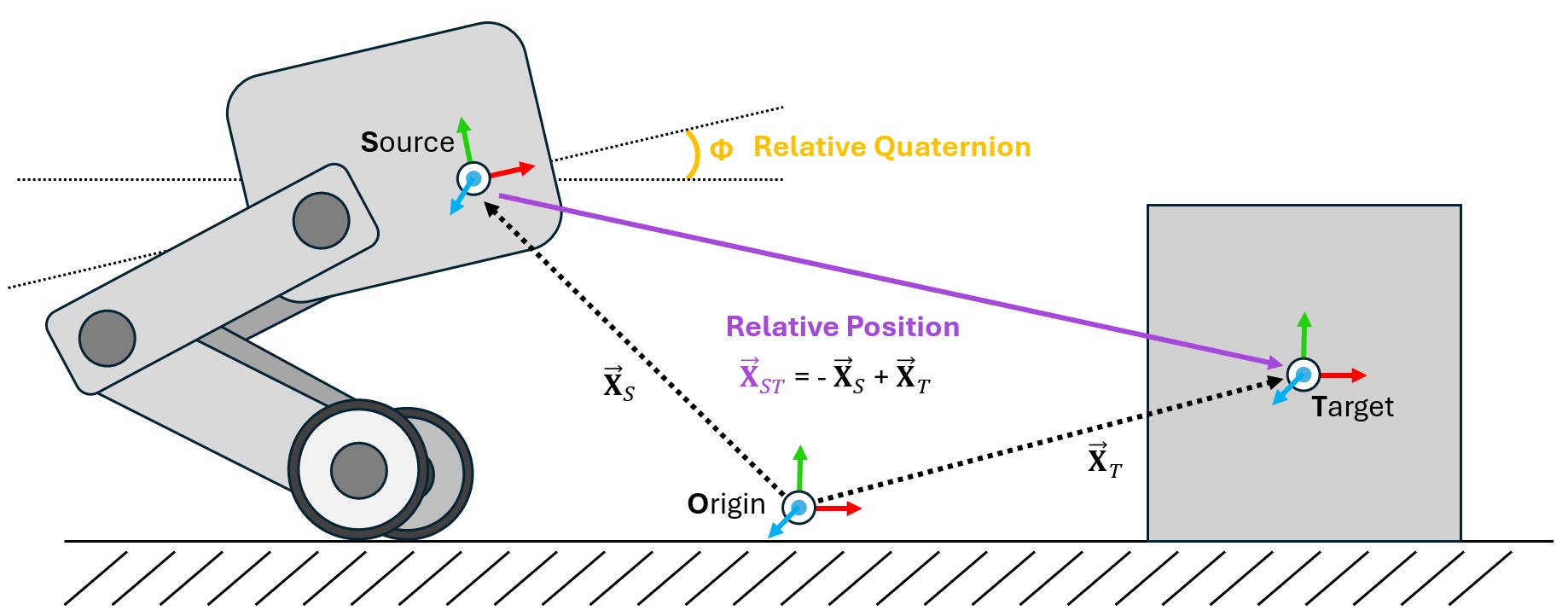
One of the most common operations that needs to be performed within a physics simulation is the frame transformation: rewriting a vector or quaternion in the basis of an arbitrary euclidean coordinate system. There are many ways to accomplish this within Isaac and USD, but these methods can be cumbersome to implement within Isaac Lab’s GPU based simulation and cloned environments. To mitigate this problem, we have designed the Frame Transformer Sensor, that tracks and calculate the relative frame transformations for rigid bodies of interest to the scene.
The sensory is minimally defined by a source frame and a list of target frames. These definitions take the form of a prim path (for the source) and list of regex capable prim paths the rigid bodies to be tracked (for the targets).
from isaaclab.utils.configclass import configclass

##
# Pre-defined configs
##
from isaaclab_assets.robots.anymal import ANYMAL_C_CFG  # isort: skip


@configclass
class FrameTransformerSensorSceneCfg(InteractiveSceneCfg):
    """Design the scene with sensors on the robot."""

    # ground plane
    ground = AssetBaseCfg(prim_path="/World/defaultGroundPlane", spawn=sim_utils.GroundPlaneCfg())

    # lights
    dome_light = AssetBaseCfg(
        prim_path="/World/Light", spawn=sim_utils.DomeLightCfg(intensity=3000.0, color=(0.75, 0.75, 0.75))
    )

    # robot
    robot = ANYMAL_C_CFG.replace(prim_path="{ENV_REGEX_NS}/Robot")

    # Rigid Object
    cube = RigidObjectCfg(
        prim_path="{ENV_REGEX_NS}/Cube",
        spawn=sim_utils.CuboidCfg(
            size=(1, 1, 1),
            rigid_props=sim_utils.RigidBodyPropertiesCfg(),
            mass_props=sim_utils.MassPropertiesCfg(mass=100.0),
            collision_props=sim_utils.CollisionPropertiesCfg(),
            physics_material=sim_utils.RigidBodyMaterialCfg(static_friction=1.0),
            visual_material=sim_utils.PreviewSurfaceCfg(diffuse_color=(0.0, 1.0, 0.0), metallic=0.2),
        ),
        init_state=RigidObjectCfg.InitialStateCfg(pos=(5, 0, 0.5)),
    )

    specific_transforms = FrameTransformerCfg(
        prim_path="{ENV_REGEX_NS}/Robot/base",
        target_frames=[
            FrameTransformerCfg.FrameCfg(prim_path="{ENV_REGEX_NS}/Robot/LF_FOOT"),
            FrameTransformerCfg.FrameCfg(prim_path="{ENV_REGEX_NS}/Robot/RF_FOOT"),
        ],
        debug_vis=True,
    )

    cube_transform = FrameTransformerCfg(
        prim_path="{ENV_REGEX_NS}/Robot/base",
        target_frames=[FrameTransformerCfg.FrameCfg(prim_path="{ENV_REGEX_NS}/Cube")],
We can now run the scene and query the sensor for data
def run_simulator(sim: sim_utils.SimulationContext, scene: InteractiveScene):
  .
  .
  .
  # Simulate physics
  while simulation_app.is_running():
    .
    .
    .

    # print information from the sensors
    print("-------------------------------")
    print(scene["specific_transforms"])
    print("relative transforms:", scene["specific_transforms"].data.target_pos_source)
    print("relative orientations:", scene["specific_transforms"].data.target_quat_source)
    print("-------------------------------")
    print(scene["cube_transform"])
    print("relative transform:", scene["cube_transform"].data.target_pos_source)
    print("-------------------------------")
    print(scene["robot_transforms"])
    print("relative transforms:", scene["robot_transforms"].data.target_pos_source)
Let’s take a look at the result for tracking specific objects. First, we can take a look at the data coming from the sensors on the feet
-------------------------------
FrameTransformer @ '/World/envs/env_.*/Robot/base':
        tracked body frames: ['base', 'LF_FOOT', 'RF_FOOT']
        number of envs: 1
        source body frame: base
        target frames (count: ['LF_FOOT', 'RF_FOOT']): 2

relative transforms: tensor([[[ 0.4658,  0.3085, -0.4840],
        [ 0.4487, -0.2959, -0.4828]]], device='cuda:0')
relative orientations: tensor([[[ 0.9623,  0.0072, -0.2717, -0.0020],
        [ 0.9639,  0.0052, -0.2663, -0.0014]]], device='cuda:0')
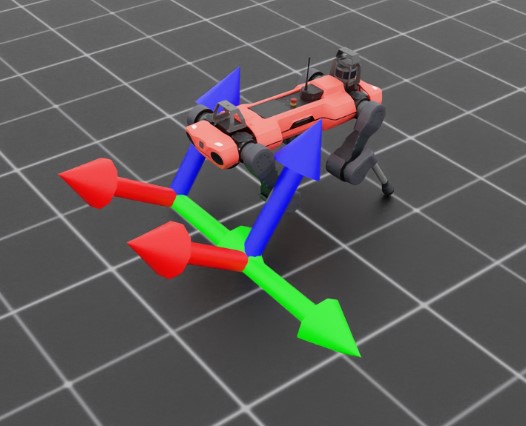
By activating the visualizer, we can see that the frames of the feet are rotated “upward” slightly. We can also see the explicit relative positions and rotations by querying the sensor for data, which returns these values as a list with the same order as the tracked frames. This becomes even more apparent if we examine the transforms specified by regex.
-------------------------------
FrameTransformer @ '/World/envs/env_.*/Robot/base':
        tracked body frames: ['base', 'LF_FOOT', 'LF_HIP', 'LF_SHANK', 'LF_THIGH', 'LH_FOOT', 'LH_HIP', 'LH_SHANK', 'LH_THIGH', 'RF_FOOT', 'RF_HIP', 'RF_SHANK', 'RF_THIGH', 'RH_FOOT', 'RH_HIP', 'RH_SHANK', 'RH_THIGH', 'base']
        number of envs: 1
        source body frame: base
        target frames (count: ['LF_FOOT', 'LF_HIP', 'LF_SHANK', 'LF_THIGH', 'LH_FOOT', 'LH_HIP', 'LH_SHANK', 'LH_THIGH', 'RF_FOOT', 'RF_HIP', 'RF_SHANK', 'RF_THIGH', 'RH_FOOT', 'RH_HIP', 'RH_SHANK', 'RH_THIGH', 'base']): 17

relative transforms: tensor([[[ 4.6581e-01,  3.0846e-01, -4.8398e-01],
        [ 2.9990e-01,  1.0400e-01, -1.7062e-09],
        [ 2.1409e-01,  2.9177e-01, -2.4214e-01],
        [ 3.5980e-01,  1.8780e-01,  1.2608e-03],
        [-4.8813e-01,  3.0973e-01, -4.5927e-01],
        [-2.9990e-01,  1.0400e-01,  2.7044e-09],
        [-2.1495e-01,  2.9264e-01, -2.4198e-01],
        [-3.5980e-01,  1.8780e-01,  1.5582e-03],
        [ 4.4871e-01, -2.9593e-01, -4.8277e-01],
        [ 2.9990e-01, -1.0400e-01, -2.7057e-09],
        [ 1.9971e-01, -2.8554e-01, -2.3778e-01],
        [ 3.5980e-01, -1.8781e-01, -9.1049e-04],
        [-5.0090e-01, -2.9095e-01, -4.5746e-01],
        [-2.9990e-01, -1.0400e-01,  6.3592e-09],
        [-2.1860e-01, -2.8251e-01, -2.5163e-01],
        [-3.5980e-01, -1.8779e-01, -1.8792e-03],
        [ 0.0000e+00,  0.0000e+00,  0.0000e+00]]], device='cuda:0')
Here, the sensor is tracking all rigid body children of Robot/base, but this expression is inclusive, meaning that the source body itself is also a target. This can be seen both by examining the source and target list, where base appears twice, and also in the returned data, where the sensor returns the relative transform to itself, (0, 0, 0).
Code for frame_transformer_sensor.py
  1# Copyright (c) 2022-2026, The Isaac Lab Project Developers (https://github.com/isaac-sim/IsaacLab/blob/main/CONTRIBUTORS.md).
  2# All rights reserved.
  3#
  4# SPDX-License-Identifier: BSD-3-Clause
  5
  6import argparse
  7
  8from isaaclab.app import AppLauncher
  9
 10# add argparse arguments
 11parser = argparse.ArgumentParser(description="Example on using the frame transformer sensor.")
 12parser.add_argument("--num_envs", type=int, default=1, help="Number of environments to spawn.")
 13parser.add_argument(
 14    "--physics",
 15    default="isaacsim_physx",
 16    choices=["isaacsim_physx"],
 17    help="Physics backend.",
 18)
 19# append AppLauncher cli args
 20AppLauncher.add_app_launcher_args(parser)
 21# demos should open Kit visualizer by default
 22parser.set_defaults(visualizer=["kit"])
 23# parse the arguments
 24args_cli = parser.parse_args()
 25
 26# launch omniverse app
 27app_launcher = AppLauncher(args_cli)
 28simulation_app = app_launcher.app
 29
 30"""Rest everything follows."""
 31
 32import torch
 33
 34import isaaclab.sim as sim_utils
 35from isaaclab.assets import AssetBaseCfg, RigidObjectCfg
 36from isaaclab.scene import InteractiveScene, InteractiveSceneCfg
 37from isaaclab.sensors import FrameTransformerCfg
 38from isaaclab.utils.configclass import configclass
 39
 40##
 41# Pre-defined configs
 42##
 43from isaaclab_assets.robots.anymal import ANYMAL_C_CFG  # isort: skip
 44
 45
 46@configclass
 47class FrameTransformerSensorSceneCfg(InteractiveSceneCfg):
 48    """Design the scene with sensors on the robot."""
 49
 50    # ground plane
 51    ground = AssetBaseCfg(prim_path="/World/defaultGroundPlane", spawn=sim_utils.GroundPlaneCfg())
 52
 53    # lights
 54    dome_light = AssetBaseCfg(
 55        prim_path="/World/Light", spawn=sim_utils.DomeLightCfg(intensity=3000.0, color=(0.75, 0.75, 0.75))
 56    )
 57
 58    # robot
 59    robot = ANYMAL_C_CFG.replace(prim_path="{ENV_REGEX_NS}/Robot")
 60
 61    # Rigid Object
 62    cube = RigidObjectCfg(
 63        prim_path="{ENV_REGEX_NS}/Cube",
 64        spawn=sim_utils.CuboidCfg(
 65            size=(1, 1, 1),
 66            rigid_props=sim_utils.RigidBodyPropertiesCfg(),
 67            mass_props=sim_utils.MassPropertiesCfg(mass=100.0),
 68            collision_props=sim_utils.CollisionPropertiesCfg(),
 69            physics_material=sim_utils.RigidBodyMaterialCfg(static_friction=1.0),
 70            visual_material=sim_utils.PreviewSurfaceCfg(diffuse_color=(0.0, 1.0, 0.0), metallic=0.2),
 71        ),
 72        init_state=RigidObjectCfg.InitialStateCfg(pos=(5, 0, 0.5)),
 73    )
 74
 75    specific_transforms = FrameTransformerCfg(
 76        prim_path="{ENV_REGEX_NS}/Robot/base",
 77        target_frames=[
 78            FrameTransformerCfg.FrameCfg(prim_path="{ENV_REGEX_NS}/Robot/LF_FOOT"),
 79            FrameTransformerCfg.FrameCfg(prim_path="{ENV_REGEX_NS}/Robot/RF_FOOT"),
 80        ],
 81        debug_vis=True,
 82    )
 83
 84    cube_transform = FrameTransformerCfg(
 85        prim_path="{ENV_REGEX_NS}/Robot/base",
 86        target_frames=[FrameTransformerCfg.FrameCfg(prim_path="{ENV_REGEX_NS}/Cube")],
 87        debug_vis=False,
 88    )
 89
 90    robot_transforms = FrameTransformerCfg(
 91        prim_path="{ENV_REGEX_NS}/Robot/base",
 92        target_frames=[FrameTransformerCfg.FrameCfg(prim_path="{ENV_REGEX_NS}/Robot/.*")],
 93        debug_vis=False,
 94    )
 95
 96
 97def run_simulator(sim: sim_utils.SimulationContext, scene: InteractiveScene):
 98    """Run the simulator."""
 99    # Define simulation stepping
100    sim_dt = sim.get_physics_dt()
101    sim_time = 0.0
102    count = 0
103
104    # Simulate physics
105    while simulation_app.is_running():
106        if count % 500 == 0:
107            # reset counter
108            count = 0
109            # reset the scene entities
110            # root state
111            # we offset the root state by the origin since the states are written in simulation world frame
112            # if this is not done, then the robots will be spawned at the (0, 0, 0) of the simulation world
113            root_pose = scene["robot"].data.default_root_pose.torch.clone()
114            root_pose[:, :3] += scene.env_origins
115            scene["robot"].write_root_pose_to_sim_index(root_pose=root_pose)
116            root_vel = scene["robot"].data.default_root_vel.torch.clone()
117            scene["robot"].write_root_velocity_to_sim_index(root_velocity=root_vel)
118            # set joint positions with some noise
119            joint_pos, joint_vel = (
120                scene["robot"].data.default_joint_pos.torch.clone(),
121                scene["robot"].data.default_joint_vel.torch.clone(),
122            )
123            joint_pos += torch.rand_like(joint_pos) * 0.1
124            scene["robot"].write_joint_position_to_sim_index(position=joint_pos)
125            scene["robot"].write_joint_velocity_to_sim_index(velocity=joint_vel)
126            # clear internal buffers
127            scene.reset()
128            print("[INFO]: Resetting robot state...")
129        # Apply default actions to the robot
130        # -- generate actions/commands
131        targets = scene["robot"].data.default_joint_pos.torch
132        # -- apply action to the robot
133        scene["robot"].set_joint_position_target_index(target=targets)
134        # -- write data to sim
135        scene.write_data_to_sim()
136        # perform step
137        sim.step()
138        # update sim-time
139        sim_time += sim_dt
140        count += 1
141        # update buffers
142        scene.update(sim_dt)
143
144        # print information from the sensors
145        print("-------------------------------")
146        print(scene["specific_transforms"])
147        print("relative transforms:", scene["specific_transforms"].data.target_pos_source)
148        print("relative orientations:", scene["specific_transforms"].data.target_quat_source)
149        print("-------------------------------")
150        print(scene["cube_transform"])
151        print("relative transform:", scene["cube_transform"].data.target_pos_source)
152        print("-------------------------------")
153        print(scene["robot_transforms"])
154        print("relative transforms:", scene["robot_transforms"].data.target_pos_source)
155
156
157def main():
158    """Main function."""
159
160    # Initialize the simulation context
161    sim_cfg = sim_utils.SimulationCfg(dt=0.005, device=args_cli.device)
162    sim = sim_utils.SimulationContext(sim_cfg)
163    # Set main camera
164    sim.set_camera_view(eye=[3.5, 3.5, 3.5], target=[0.0, 0.0, 0.0])
165    # design scene
166    scene_cfg = FrameTransformerSensorSceneCfg(num_envs=args_cli.num_envs, env_spacing=2.0)
167    scene = InteractiveScene(scene_cfg)
168    # Play the simulator
169    sim.reset()
170    # Now we are ready!
171    print("[INFO]: Setup complete...")
172    # Run the simulator
173    run_simulator(sim, scene)
174
175
176if __name__ == "__main__":
177    # run the main function
178    main()
179    # close sim app
180    simulation_app.close()