



Native reset-state buffers#
A reset bank separates prepared starting states from the policy that selects them.
The shared API lives in isaaclab.envs.reset: ResetStateBuffer
owns Warp snapshots, and ResetStateSampler records outcomes
and selects entries. Tasks own generation, physical validity, and restoration through
public asset writers. The existing core Lift task demonstrates this as a reset event.
Prepare storage#
Construct a buffer from a nested dictionary of Warp arrays. Every leaf has the same
leading state count and device. ProxyArray and same-device
Torch inputs are accepted at the boundary; storage and runtime operations use Warp.
Construction copies the inputs.
import warp as wp
from isaaclab.envs.reset import ResetStateBuffer

empty = ResetStateBuffer({})
assert empty.num_states == 0

# A single, task-validated default row can populate the whole bank.
defaults = {"joint_pos": robot.data.default_joint_pos.warp[:1]}
buffer = ResetStateBuffer(defaults, num_states=1024)
An empty dictionary has no schema and contains zero states. A tree of zero-row arrays also represents an empty buffer, retaining its schema. Nonempty reads and sampling require prepared entries. An empty schema cannot allocate populated states without being given their fields.
The states property returns copied ProxyArray snapshots for inspection or
persistence. Compatible saved tensors can also initialize a bank:
import torch

saved_states = torch.load("reset_states.pt", map_location=device, weights_only=True)
buffer = ResetStateBuffer(saved_states)
The task must establish asset, backend, field, unit, and controller compatibility. Store positions relative to environment origins when sharing starts across worlds. Storage does not perform collision checks or manage a disk cache.
Select and restore with masks#
The native interface uses full-environment arrays and a Boolean mask. Allocate output storage before capture, then reuse it:
from isaaclab.envs.reset import ResetStateSampler, ResetStateSamplerCfg

sampler = ResetStateSampler(ResetStateSamplerCfg(seed=42), num_envs, buffer.num_states, device)
mask = wp.ones(num_envs, dtype=wp.bool, device=device)
restored = {"joint_pos": wp.empty((num_envs, robot.num_joints), dtype=float, device=device)}

# Record the episodes that ended before assigning their replacement starts.
sampler.reset(mask, success=episode_success, valid=completed_episode)
buffer.get_state(sampler.indices, out=restored, mask=mask)
robot.write_joint_position_to_sim_mask(position=restored["joint_pos"], env_mask=mask)
Only masked environments receive new assignments, random draws, or restored values.
Omit outcomes on the initial draw, and exclude manual or zero-step resets with
valid. Record the previous episode before clearing its success flag. Simultaneous
outcomes for the same entry are recorded in environment-index order; each entry
retains its latest history_length outcomes.
Pass a full-environment state_ids array to sampler.reset for explicit starts.
Optional constructor state_ids gives entries stable integer labels, such as
procedural recipe seeds. sampler.indices gives dense storage positions for
buffer.get_state and sampler.state_ids gives the corresponding labels.
Catalog labels reserve -1 for an unassigned environment. Assignments, rates, counts, and probabilities
are borrowed ProxyArray outputs: treat them as read-only and use explicit requests
to change assignments. Invalid requested IDs are reported in invalid_requests
on the device, so inspection can happen outside capture.
For catalogs partitioned by asset combination, use group_ids and num_groups.
Partitions contain equal contiguous ranges; each environment draws within its group.
The buffer itself has no group metadata. Legacy manager terms can pass env_ids=
to the sampler; that shim populates a preallocated mask.
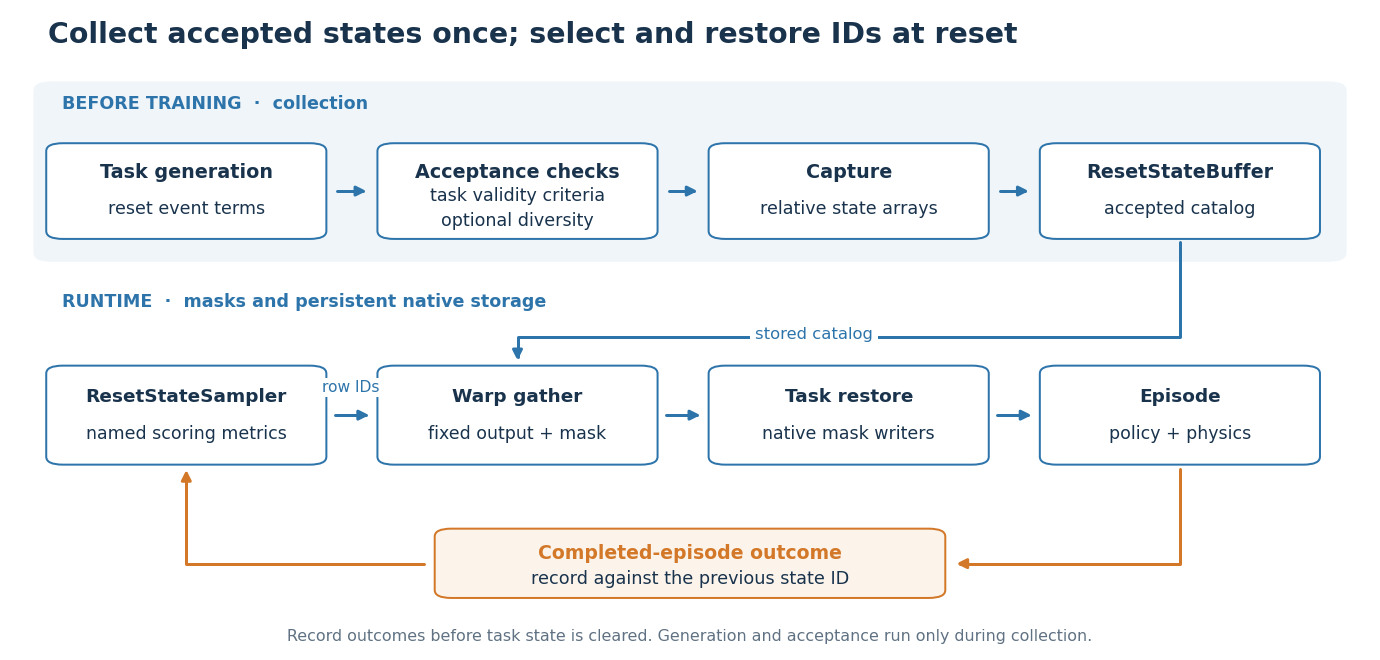
Generation and validation run during initialization. Runtime uses fixed storage and masks.#
Capture the runtime#
Warm the configured path before capture. The sampler and get_state(..., out=...)
can run in a CUDA graph. Lift’s newton_mjwarp preset supports capturing both
operations and the asset writes together. With OvPhysX or Kit-based PhysX, run Lift’s
asset writes outside capture.
Update the contents of the bound arrays in place between graph replays. The choice to provide outcomes or explicit IDs is fixed at capture time.
def reset_selected():
    sampler.reset(mask, success=episode_success, valid=completed_episode)
    buffer.get_state(sampler.indices, out=restored, mask=mask)
    robot.write_joint_position_to_sim_mask(position=restored["joint_pos"], env_mask=mask)

reset_selected()
with wp.ScopedCapture(device=device) as capture:
    reset_selected()
wp.capture_launch(capture.graph)
Run prefill, rejection loops, loading, inspection, and logging outside capture. Use
get_state(ids) to allocate a snapshot for inspection. The example captures only
the reset operations.
Set ResetStateSamplerCfg.seed to initialize the sampler’s per-environment random streams.
Use sampler.reseed(seed) between rollouts to restart those streams while retaining
history and assignments. A captured graph observes the new streams.
Configure useful practice#
The default adds uniform weight to a Beta kernel score that peaks at 50 percent recent success. This favors starts of intermediate difficulty while giving every entry a chance to be drawn. Concentration narrows the score’s peak while keeping its height fixed at one. When all success rates are zero, the default draws uniformly. Include valid starts the policy can solve early so that the scores can begin to distinguish entries.
from isaaclab.envs.reset import BetaSamplingScoreCfg

adaptive = ResetStateSamplerCfg(
    history_length=50,
    scores=[BetaSamplingScoreCfg(target=0.5, kappa=2.0, weight=0.25)],
    uniform_weight=0.0501,
)
uniform = ResetStateSamplerCfg(scores=[])
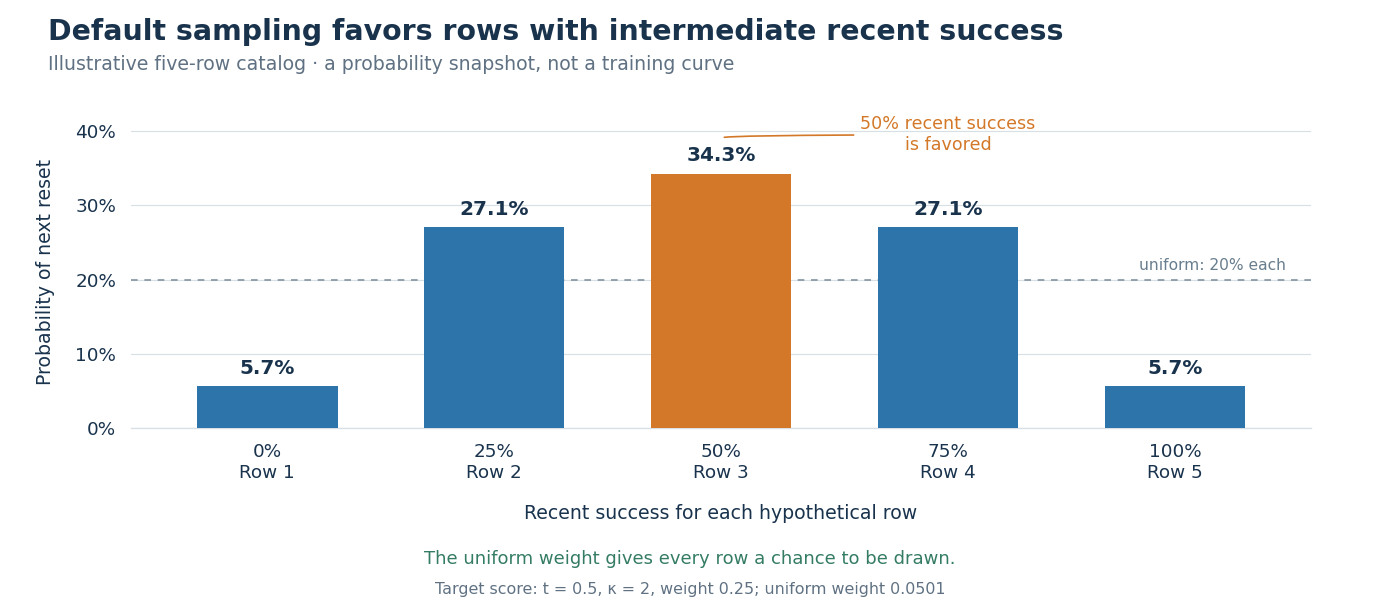
Example probabilities for five states with different success rates. The sampler
adds 0.0501 to each score, then normalizes the weights within each asset group.#
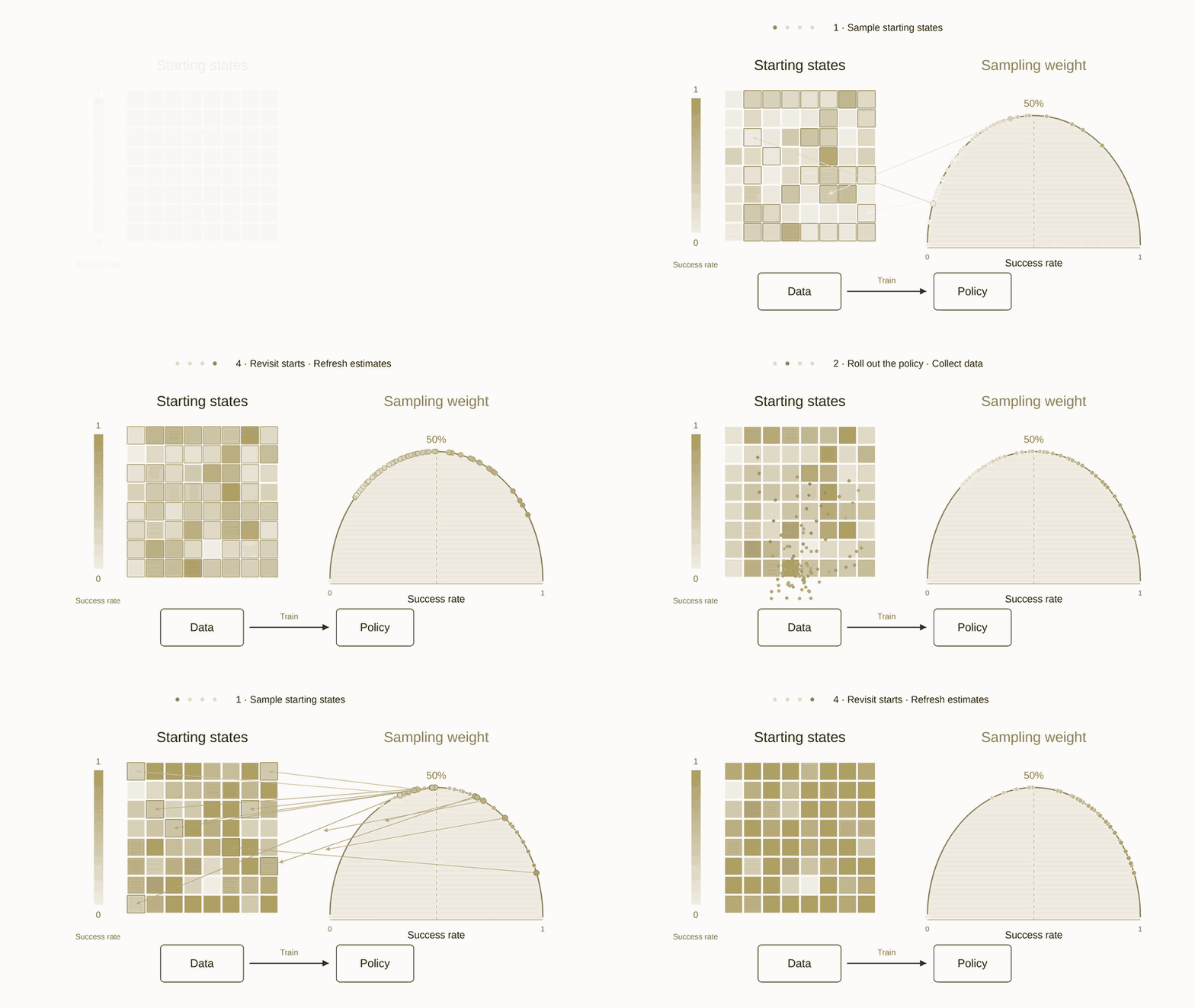

The animation illustrates how rollouts and training change which starts are most useful. As the policy revisits starts, their estimated success rates shift along the Beta score curve. The curve shows the score before adding uniform weight. Animation courtesy of Octi Zhang.
Custom configurations derive from SamplingScoreCfg.
Their scorer implements score(metrics, out) with Warp operations on preallocated
storage. Borrow additional per-entry metric arrays through metrics= at sampler
construction and update them in place. The sampler supplies success_rate and
episode_counts so a score can account for both difficulty and how much evidence
it has. Tasks can supply other signals, such as learning progress or staleness.
The sampler uses a fixed catalog and weighted draws with replacement. Tasks that generate new entries during training or require scheduled coverage, such as visiting each row once per cycle, own that scheduling policy. The assignment must match the state actually played. When restoring a snapshot from outside the catalog, exclude the resulting episode from catalog outcome tracking.
Use the existing Lift reset event#
Isaac-Lift-Franka already uses core/lift/mdp/events.py::conditional_reset.
Its ordinary reset terms generate candidate starts, its criteria reject invalid
states, and its optional diversity descriptor spreads the retained starts. Prefill
runs once per asset-combination group before replay begins. The event now uses the
shared buffer and sampler; no additional task or environment subclass is required.
Configure its existing events.conditional_reset.params entries:
buffer_size_per_groupcontrols retained starts per asset combination.valid_criteriaandmax_prefill_iterscontrol acceptance and the attempt budget.diversity_featureoptionally spreads starts over a task-defined descriptor.reset_samplerconfigures history, scores, and independent random streams;Noneselects uniformly without recording outcomes.
After ordinary initialization, the event’s reset_mask(mask, state_ids=ids) method
replays explicit starts. With adaptive sampling enabled, supply
completed=natural_episode_mask to record outcomes for completed natural episodes
that took at least one step. The event credits the existing success reward’s sticky
flag before the reward manager clears it and restores root-link poses, COM velocities,
joints, and controller targets through public mask writers.
Migrating existing reset configurations#
Lift’s success_monitor event parameter is replaced by reset_sampler.
NIST’s sampling parameter takes ResetStateSamplerCfg with core score
configurations. Its separate success_monitor_cfg still configures outcome
history. Set metric="monitor_success_rate" on a score to use those rates.