



Manage Asset Downloads#
Isaac Lab assets are hosted on AWS S3 and are downloaded as a workflow needs them. Use this guide to cache frequently used assets, migrate an existing Nucleus setup, or select the regional asset service for mainland China.
Cache remote assets#
Enable Hub Workstation Cache when repeated downloads are slow or the workstation has intermittent network access.
Launch Isaac Sim:
uv run --extra isaacsim isaaclab -s
uv run --extra isaacsim isaaclab -s
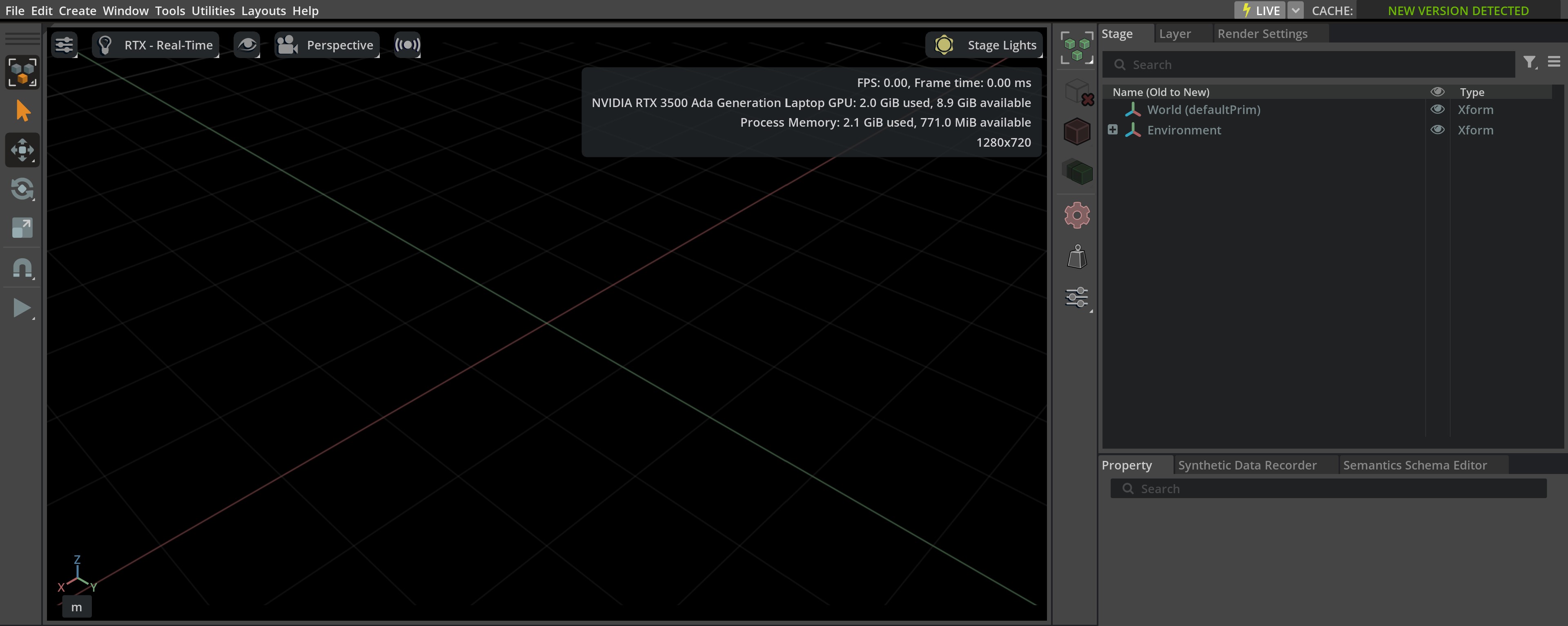
Select the CACHE: message in the upper-right corner and enable Hub Workstation Cache. The first load
still downloads each asset; later runs use the local cache.
Detailed asset caching and Nucleus migration notes
Asset Caching
Assets used in Isaac Lab are hosted on AWS S3 buckets on the cloud. Asset loading time can depend on your network connection and geographical location. In some cases, it is possible that asset loading times can be long when assets are pulled from the AWS servers.
If you run into cases where assets take a few minutes to load for each run, we recommend enabling asset caching following the below steps.
First, launch the Isaac Sim application:
uv run --extra isaacsim isaaclab -s
uv run --extra isaacsim isaaclab -s
On the top right of the Isaac Lab or Isaac Sim app, look for the icon labeled CACHE:.
You may see a message such as HUB NOT DETECTED or NEW VERSION DETECTED.
Click the message to enable Hub. Hub automatically manages local caching for Isaac Lab assets, so subsequent runs will use cached files instead of downloading from AWS each time.
Hub provides better control and management of cached assets, making workflows faster and more reliable, especially in environments with limited or intermittent internet access.
Note
The first time you run Isaac Lab, assets will still need to be pulled from the cloud, which could lead to longer loading times. Once cached, loading times will be significantly reduced on subsequent runs.
Using a Local Asset Root
Machines that are air-gapped or otherwise unable to reach the AWS S3 buckets can point Isaac Lab at a
local or self-hosted copy of the assets. Set the ISAACSIM_ASSET_ROOT environment variable before
launching:
export ISAACSIM_ASSET_ROOT=/path/to/Assets/Isaac/X.Y
set ISAACSIM_ASSET_ROOT=C:\path\to\Assets\Isaac\X.Y
The variable must point at the versioned asset root, that is the directory containing Isaac and
NVIDIA. It takes precedence over the value shipped in the experience files, and it always applies to
the Isaac Lab asset paths such as ISAAC_NUCLEUS_DIR. The Isaac Sim asset
root resolves to the same value when you use one of the provided Isaac Lab experiences, because those
load isaacsim.storage.native. A custom experience that does not build on one of them may leave the
Isaac Sim asset root pointing at the cloud.
Isaac Lab supports the ISAACSIM_ASSET_ROOT and ISAACSIM_ASSET_REGION_PROFILE environment variables
for runtime asset selection. It resolves asset paths once, when isaaclab.utils.assets is imported, so setting
persistent.isaac.asset_root.default on the command line or changing it at runtime does not move them,
even though Isaac Sim itself honors those forms. Editing persistent.isaac.asset_root.default in the
experience file does work, because that is the value Isaac Lab reads when the variable is unset.
Note
If you previously redirected Isaac Lab assets by editing persistent.isaac.asset_root.cloud in an
experience file, that edit no longer has any effect. Isaac Lab now reads
persistent.isaac.asset_root.default first, and the shipped experiences leave it pointing at the
cloud. Set ISAACSIM_ASSET_ROOT instead, or edit persistent.isaac.asset_root.default.
For instructions on downloading the asset pack, see the Isaac Sim asset documentation.
Nucleus
Before Isaac Sim 4.5, assets were accessed via the Omniverse Nucleus server, including setups with local Nucleus instances.
Warning
Starting with Isaac Sim 4.5, the Omniverse Nucleus server and Omniverse Launcher are deprecated. Existing Nucleus setups will continue to work, so if you have a local Nucleus server already configured, you may continue to use it.
Omniverse Nucleus and Omniverse Launcher are deprecated starting with Isaac Sim 4.5. Existing local Nucleus installations continue to work.
Select an asset region#
An Asset Region Profile selects a compatible asset root and configures any storage settings required for that service. Isaac Lab provides these profiles:
Profile |
Use |
|---|---|
|
Primary public asset service and explicit switchback profile. |
|
Regional asset service for users in mainland China. |
Set the profile before launching Isaac Lab. Clear ISAACSIM_ASSET_ROOT first because an explicit
asset-root override takes precedence over the selected profile.
unset ISAACSIM_ASSET_ROOT
export ISAACSIM_ASSET_REGION_PROFILE=china
set ISAACSIM_ASSET_ROOT=
set ISAACSIM_ASSET_REGION_PROFILE=china
Isaac Lab launchers and asset helpers apply the profile automatically. The same variable also selects
the profile when Isaac Lab launches Isaac Sim. In kit-less mode, Isaac Lab configures the required
omni.client routing without requiring Isaac Sim.
A standalone kit-less script that calls omni.client before launching an Isaac Lab runtime must
initialize the profile first:
from isaaclab.utils.assets import configure_asset_region_profile

configure_asset_region_profile()
To return to the primary service, clear ISAACSIM_ASSET_ROOT and select the us profile.
The china profile publishes an
asset availability manifest.
The isaac_version field identifies the asset release. Each asset_path is the full path to a
file relative to the versioned asset root’s Isaac directory. A status value of available
reports that the file is mirrored, reason_code explains other statuses when provided, and
checked_at records when the status last changed. A path with no row is not mirrored. The manifest
does not confirm the availability of paths outside the root’s Isaac directory.
Build paths from profile-resolved constants such as
ISAAC_NUCLEUS_DIR and
ISAACLAB_NUCLEUS_DIR. Do not hardcode the profile’s storage endpoint or
derive direct object URLs from the manifest. Opening an object-storage URL directly in a browser or
with curl can return HTTP 403 because it bypasses the profile’s CDN routing.