

Performance and scaling#
Arena performance spans environment creation and evaluation execution. This page reports reference measurements for three parts of that workflow:
Parallel environments within one Run: advancing many environments together on one GPU to increase rollout throughput.
Independent Runs across GPUs: using OSMO to execute Runs concurrently and reduce the time needed to finish an Experiment.
Agentic environment generation: producing the first structured environment spec from a prompt, then resolving a valid spec into a pool of layouts.
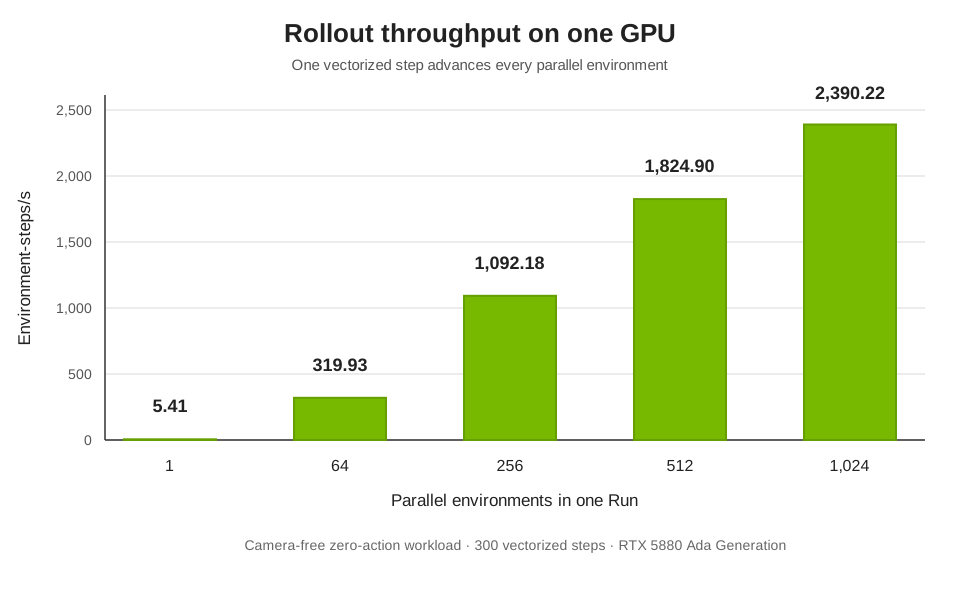
An environment-step is one simulation step completed by one environment. A vectorized step advances every parallel environment in a Run once. For example, one vectorized step with 256 parallel environments completes 256 environment-steps.
The two evaluation-execution benchmarks used the same camera-free workload: the DROID
Rubik’s-cube-into-bowl task at the Maple table, the zero_action policy that sends zero-valued
actions, and 300 vectorized steps per Run. The agentic-generation benchmark uses the separate
workload described in its section.
Note
These are preliminary reference measurements collected for this release. They show how the specified workloads performed on the named hardware and model; they are not performance guarantees for other tasks or systems.
Parallel environments within one Run#
The single-GPU benchmark ran a fresh Arena process for each environment count on one NVIDIA RTX 5880 Ada Generation GPU with 49,140 MiB of memory. Rollout throughput is the number of parallel environments divided by the mean time for one vectorized step. It excludes process startup, environment construction, report generation, and shutdown.
The host also used an Intel Core i9-10920X CPU with 12 cores and 24 threads, 62 GiB of system memory, Ubuntu 22.04.5, and NVIDIA driver 560.35.05.
Parallel environments |
Mean vectorized step |
Rollout throughput |
|---|---|---|
1 |
185.0 ms |
5.41 environment-steps/s |
64 |
200.0 ms |
319.93 environment-steps/s |
256 |
234.4 ms |
1,092.18 environment-steps/s |
512 |
280.6 ms |
1,824.90 environment-steps/s |
1,024 |
428.4 ms |
2,390.22 environment-steps/s |
Independent Runs across GPUs with OSMO#
The distributed benchmark used one Experiment containing eight identical Runs. Each Run created 256 parallel environments, advanced them for 300 steps, and used one NVIDIA L40 GPU. OSMO was configured to execute at most 1, 2, 4, or 8 Runs at once.
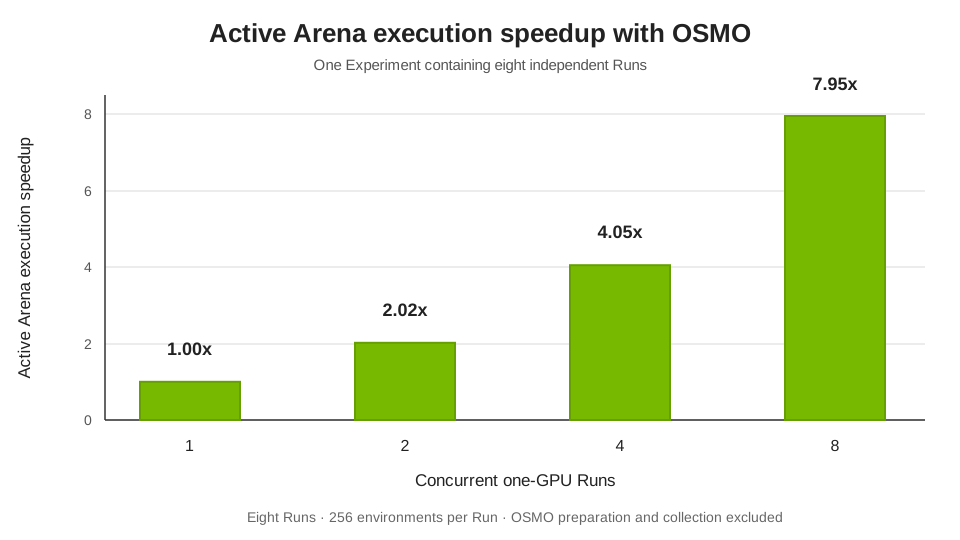
With fewer than eight GPUs, OSMO executed the Runs in consecutive groups. The active Arena execution time below is the sum of the active time for those groups, from the first Arena process starting until the last process in each group exited. It includes Arena and Isaac Sim startup, environment construction, rollout, and shutdown. It excludes OSMO queueing, container-image downloads, inactive time between groups, and final output collection.
Concurrent Runs and GPUs |
Scheduling of eight Runs |
Active Arena execution time |
Speedup |
Mean Run duration |
|---|---|---|---|---|
1 |
Eight consecutive Runs |
1,255.2 s |
1.00x |
156.9 s |
2 |
Four groups of two |
621.0 s |
2.02x |
154.6 s |
4 |
Two groups of four |
310.2 s |
4.05x |
154.3 s |
8 |
All eight together |
157.8 s |
7.95x |
154.0 s |
Executing all eight Runs at once reduced active Arena execution time from 20 minutes 55 seconds to 2 minutes 38 seconds, a 7.95x speedup. The mean duration of an individual Run changed by less than 2% across the four measurements. All 32 Runs completed successfully; the eight-GPU configuration used six worker nodes.
Using both scaling axes#
The two approaches address different parts of an evaluation and can be combined. Parallel environments increase the amount of simulation work completed by each Run on its GPU. Distributing independent Runs lets OSMO execute more of the Experiment at the same time across available GPUs and worker nodes.
Rollout benchmark scope#
The single-GPU test ran on a local engineering workstation, not a controlled performance lab system.
The workload did not render cameras or run policy inference. Cameras, policies, scene contents, and physics settings can change both throughput and capacity.
The single-GPU and OSMO benchmarks used different GPU models and software builds. Their absolute step times should not be compared directly.
Arena’s component timers use CPU wall-clock time without explicit CUDA synchronization. They are rollout diagnostics, not GPU kernel measurements.
Full OSMO submission time is not used for the distributed speedup because container-image cache state differed between submissions.
Agentic environment generation#
This benchmark measures the responsiveness and execution latency of Arena’s agentic environment generation pipeline. It answers two questions:
How long after a natural-language request does the agent return its first structured environment spec?
How long does Arena take to turn a valid environment spec into a resolved pool of Isaac Lab layouts?
Benchmark definition#
The benchmark reports wall-clock p50, p95, and p99 latency. Each environment and configuration was measured 100 times.
Time to first environment spec is measured from the request being sent until the first parseable, structured environment spec is available:
Time from valid spec to resolved layouts is measured from invoking the environment run command until the layout pool and its object and robot placements are resolved and validated:
A valid spec passes the fixed automated schema and semantic checks. SimulationApp startup is excluded from layout-resolution latency.
The benchmark does not measure:
Time to the first valid, repaired, or user-approved spec. The first-spec metric stops at the first parseable spec.
Correctness, task fidelity, asset selection, semantic quality, or other model-dependent quality measures.
Time spent reviewing or manually editing a generated spec, layout, task, asset choice, or placement.
Human-assisted completion rate, review throughput, or time to a human-approved environment.
Benchmark coverage#
The environments vary scene complexity, object count, object source, and whether the objects are homogeneous or heterogeneous. Layout resolution also varies the number of parallel environments. Each parallel environment uses five cached layouts.
Environment family |
Base request |
Variants |
|---|---|---|
Tabletop homogeneous pick and place |
DROID picks a banana to a plate on a maple tabletop. |
0, 6, or 14 fruit/vegetable distractors; SimReady beverage can and basket variant |
Tabletop heterogeneous pick and place |
DROID picks fruit to a plate on a tabletop. |
Heterogeneous fruit object set |
Kitchen homogeneous pick and place |
DROID picks a banana to a plate on a kitchen countertop. DROID is next to the countertop, on the floor. |
0, 6, or 14 fruit/vegetable distractors |
Kitchen open door |
DROID opens the fridge door in the kitchen. DROID is next to the fridge, on the floor. |
Referenced articulated fridge |
Factors expected to affect prompt-to-spec latency include the number of objects and relations, scene complexity, SimReady Search API use, inference endpoint, and agentic model. Factors expected to affect layout resolution include GPU, layout-pool size, the number of objects and relations, homogeneous versus heterogeneous geometry, and scene complexity. See How Model and Endpoint Affect Generation Metrics for how model and endpoint selection affect generation latency and reliability.
Prompt to first environment spec#
The agentic model was openai/openai/gpt-5.6-terra on an internal endpoint. Requests used NVIDIA campus
Ethernet. Every environment returned a parseable first spec in all 100 trials.
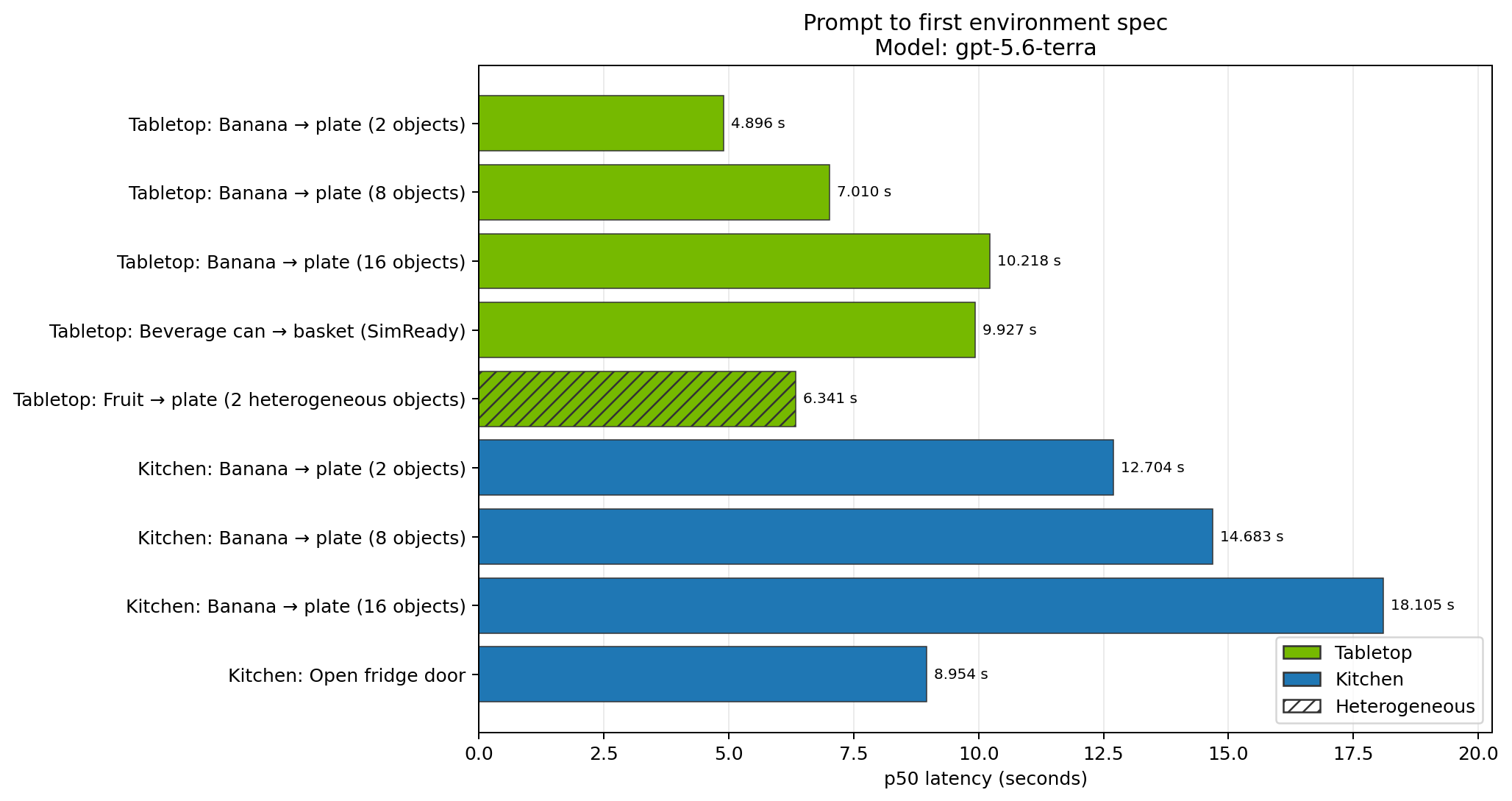
Median prompt-to-first-environment-spec latency. Hatching identifies the heterogeneous-object case.#
Environment |
Scene |
Objects |
Heterogeneous |
Success |
p50 (s) |
p95 (s) |
p99 (s) |
|---|---|---|---|---|---|---|---|
tabletop_banana_plate_distractors_0 |
Tabletop |
2 |
No |
100/100 |
4.896 |
10.020 |
25.582 |
tabletop_banana_plate_distractors_6 |
Tabletop |
8 |
No |
100/100 |
7.010 |
10.586 |
15.180 |
tabletop_banana_plate_distractors_14 |
Tabletop |
16 |
No |
100/100 |
10.218 |
14.985 |
56.083 |
tabletop_beverage_can_basket_simready |
Tabletop |
2 |
No |
100/100 |
9.927 |
14.578 |
26.546 |
tabletop_heterogeneous_fruit_plate |
Tabletop |
2 |
Yes |
100/100 |
6.341 |
10.693 |
37.385 |
kitchen_banana_plate_distractors_0 |
Kitchen |
2 |
No |
100/100 |
12.704 |
16.624 |
27.293 |
kitchen_banana_plate_distractors_6 |
Kitchen |
8 |
No |
100/100 |
14.683 |
20.607 |
47.596 |
kitchen_banana_plate_distractors_14 |
Kitchen |
16 |
No |
100/100 |
18.105 |
26.405 |
74.618 |
kitchen_open_fridge_door |
Kitchen |
0 |
No |
100/100 |
8.954 |
18.527 |
29.514 |
Valid spec to resolved layouts#
Layout resolution ran on an NVIDIA RTX 6000 Ada. The layout count is five times the number of parallel environments.
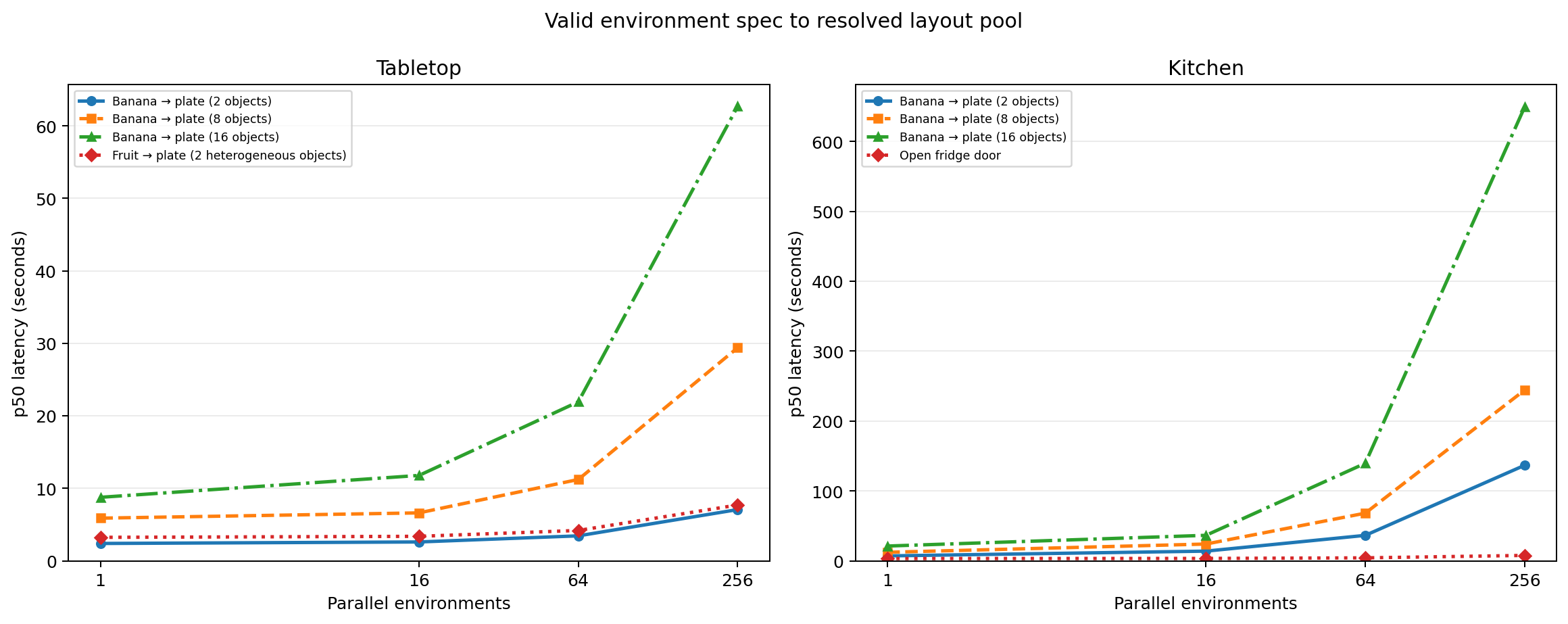
Median valid-spec-to-resolved-layout-pool latency as parallel environment count increases.#
Detailed results
Environment |
Scene |
Objects |
Heterogeneous |
Envs |
Layouts |
p50 (s) |
p95 (s) |
p99 (s) |
|---|---|---|---|---|---|---|---|---|
tabletop_banana_plate_distractors_0 |
Tabletop |
2 |
No |
1 |
5 |
2.390 |
3.192 |
3.527 |
tabletop_banana_plate_distractors_0 |
Tabletop |
2 |
No |
16 |
80 |
2.598 |
2.957 |
3.315 |
tabletop_banana_plate_distractors_0 |
Tabletop |
2 |
No |
64 |
320 |
3.441 |
4.025 |
4.377 |
tabletop_banana_plate_distractors_0 |
Tabletop |
2 |
No |
256 |
1280 |
7.065 |
8.606 |
8.918 |
tabletop_banana_plate_distractors_6 |
Tabletop |
8 |
No |
1 |
5 |
5.882 |
6.175 |
6.270 |
tabletop_banana_plate_distractors_6 |
Tabletop |
8 |
No |
16 |
80 |
6.609 |
7.113 |
7.558 |
tabletop_banana_plate_distractors_6 |
Tabletop |
8 |
No |
64 |
320 |
11.217 |
11.759 |
13.844 |
tabletop_banana_plate_distractors_6 |
Tabletop |
8 |
No |
256 |
1280 |
29.394 |
31.400 |
31.907 |
tabletop_banana_plate_distractors_14 |
Tabletop |
16 |
No |
1 |
5 |
8.757 |
10.257 |
12.556 |
tabletop_banana_plate_distractors_14 |
Tabletop |
16 |
No |
16 |
80 |
11.775 |
13.197 |
15.087 |
tabletop_banana_plate_distractors_14 |
Tabletop |
16 |
No |
64 |
320 |
21.933 |
23.591 |
24.842 |
tabletop_banana_plate_distractors_14 |
Tabletop |
16 |
No |
256 |
1280 |
62.691 |
64.580 |
65.778 |
tabletop_heterogeneous_fruit_plate |
Tabletop |
2 |
Yes |
1 |
5 |
3.234 |
3.834 |
4.157 |
tabletop_heterogeneous_fruit_plate |
Tabletop |
2 |
Yes |
16 |
80 |
3.376 |
3.627 |
3.779 |
tabletop_heterogeneous_fruit_plate |
Tabletop |
2 |
Yes |
64 |
320 |
4.186 |
4.623 |
5.235 |
tabletop_heterogeneous_fruit_plate |
Tabletop |
2 |
Yes |
256 |
1280 |
7.696 |
8.076 |
9.833 |
kitchen_banana_plate_distractors_0 |
Kitchen |
2 |
No |
1 |
5 |
6.990 |
7.639 |
7.957 |
kitchen_banana_plate_distractors_0 |
Kitchen |
2 |
No |
16 |
80 |
13.820 |
14.357 |
14.510 |
kitchen_banana_plate_distractors_0 |
Kitchen |
2 |
No |
64 |
320 |
36.388 |
37.213 |
37.648 |
kitchen_banana_plate_distractors_0 |
Kitchen |
2 |
No |
256 |
1280 |
136.645 |
139.830 |
142.016 |
kitchen_banana_plate_distractors_6 |
Kitchen |
8 |
No |
1 |
5 |
12.148 |
13.674 |
17.569 |
kitchen_banana_plate_distractors_6 |
Kitchen |
8 |
No |
16 |
80 |
23.967 |
24.519 |
24.774 |
kitchen_banana_plate_distractors_6 |
Kitchen |
8 |
No |
64 |
320 |
68.159 |
69.435 |
70.180 |
kitchen_banana_plate_distractors_6 |
Kitchen |
8 |
No |
256 |
1280 |
244.293 |
248.615 |
250.726 |
kitchen_banana_plate_distractors_14 |
Kitchen |
16 |
No |
1 |
5 |
21.098 |
22.358 |
24.218 |
kitchen_banana_plate_distractors_14 |
Kitchen |
16 |
No |
16 |
80 |
36.449 |
37.629 |
39.016 |
kitchen_banana_plate_distractors_14 |
Kitchen |
16 |
No |
64 |
320 |
139.507 |
142.345 |
146.770 |
kitchen_banana_plate_distractors_14 |
Kitchen |
16 |
No |
256 |
1280 |
649.275 |
661.445 |
679.157 |
kitchen_open_fridge_door |
Kitchen |
0 |
No |
1 |
5 |
3.234 |
3.834 |
4.157 |
kitchen_open_fridge_door |
Kitchen |
0 |
No |
16 |
80 |
3.376 |
3.627 |
3.779 |
kitchen_open_fridge_door |
Kitchen |
0 |
No |
64 |
320 |
4.186 |
4.623 |
5.235 |
kitchen_open_fridge_door |
Kitchen |
0 |
No |
256 |
1280 |
7.696 |
8.075 |
9.833 |
Tested revisions#
Agentic environment generation benchmark, September 4, 2026: Arena f641fe9df.
Single-GPU benchmark at 1, 64, and 256 environments, August 27, 2026: Arena b0cd0b38e, Isaac Lab af1bab4dc, and the camera-free benchmark configuration.
Single-GPU follow-up at 512 and 1,024 environments, September 9, 2026: the same Arena and Isaac Lab revisions and camera-free workload.
OSMO benchmark, September 6, 2026: Arena 4ee056866, Isaac Lab bb0c8e1b9, and the OSMO benchmark configuration.