

Step 2: Annotate Demonstrations#
Annotation replays the recorded actions and adds data that SoftMimicGen needs: end-effector
poses, rope simulation-node positions, and the grasp subtask termination signal.
The second subtask, bringing the rope ends together, ends with the trajectory and needs
no explicit termination signal.
Use the same physics backend that recorded the source dataset. The AutoData annotation script registers the rope environment internally, so it does not need the external callback used by Isaac Lab’s recording tool.
Automatic Annotation (Recommended)#
The rope environment publishes a grasp observation. With --auto, annotation uses its
first rising edge as the boundary between grasping and manipulating the rope.
Start the dev container, then run the command for your backend:
./docker/run_docker.sh
python scripts/annotate_demos.py \
    --env_name Isaac-Rope-Franka-Arena-IK-Rel-v0 \
    --presets newton \
    --viz none \
    --device cuda \
    --enable_cameras \
    --auto \
    --no-reset_sim_buffer_each_episode \
    --task_descriptor autodata_examples/tasks/franka_rope_softmimicgen.yaml \
    --embodiment autodata_examples/embodiments/franka_ik_rel.yaml \
    --input_file ./datasets/dataset_franka_rope_newton.hdf5 \
    --output_file ./datasets/dataset_franka_rope_newton_annotated.hdf5
Note
Use --no-reset_sim_buffer_each_episode when annotating Newton demonstrations.
python scripts/annotate_demos.py \
    --env_name Isaac-Rope-Franka-Arena-IK-Rel-v0 \
    --presets physx \
    --viz none \
    --device cuda \
    --enable_cameras \
    --auto \
    --task_descriptor autodata_examples/tasks/franka_rope_softmimicgen.yaml \
    --embodiment autodata_examples/embodiments/franka_ik_rel.yaml \
    --input_file ./datasets/dataset_franka_rope_physx.hdf5 \
    --output_file ./datasets/dataset_franka_rope_physx_annotated.hdf5
The script exports only episodes that complete the task during replay and have a valid
grasp boundary with enough steps left for the task descriptor’s offset range. Skipped
episodes are reported in the console. To watch automatic annotation, use --viz kit.
Manual Annotation (Optional)#
To mark the boundary yourself, omit --auto and use --viz kit:
python scripts/annotate_demos.py \
    --env_name Isaac-Rope-Franka-Arena-IK-Rel-v0 \
    --presets newton \
    --viz kit \
    --device cuda \
    --enable_cameras \
    --no-reset_sim_buffer_each_episode \
    --task_descriptor autodata_examples/tasks/franka_rope_softmimicgen.yaml \
    --embodiment autodata_examples/embodiments/franka_ik_rel.yaml \
    --input_file ./datasets/dataset_franka_rope_newton.hdf5 \
    --output_file ./datasets/dataset_franka_rope_newton_annotated.hdf5
Note
Use --no-reset_sim_buffer_each_episode when annotating Newton demonstrations.
python scripts/annotate_demos.py \
    --env_name Isaac-Rope-Franka-Arena-IK-Rel-v0 \
    --presets physx \
    --viz kit \
    --device cuda \
    --enable_cameras \
    --task_descriptor autodata_examples/tasks/franka_rope_softmimicgen.yaml \
    --embodiment autodata_examples/embodiments/franka_ik_rel.yaml \
    --input_file ./datasets/dataset_franka_rope_physx.hdf5 \
    --output_file ./datasets/dataset_franka_rope_physx_annotated.hdf5
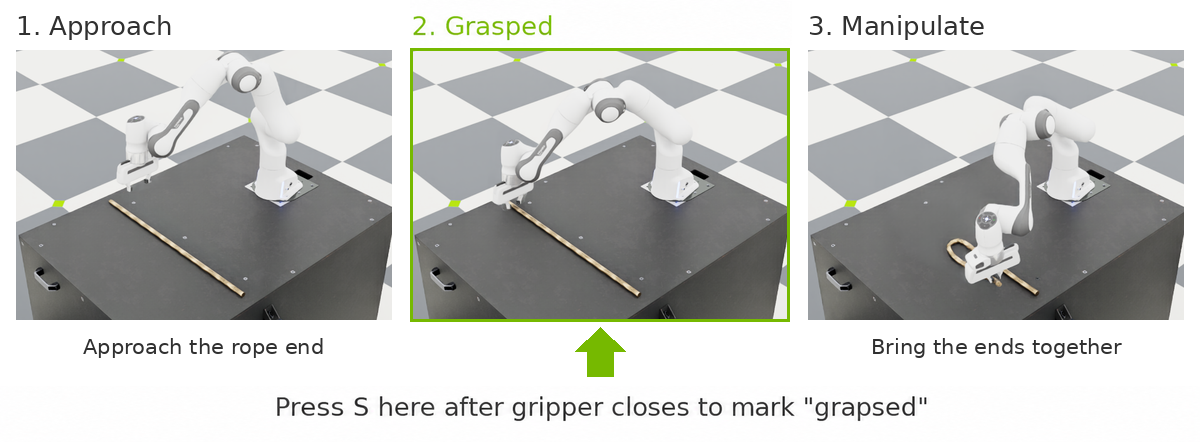
Mark grasp just after the gripper closes around the rope, before the manipulation motion begins.#
Each episode starts paused. Use these controls:
Key |
Action |
|---|---|
|
Begin / resume playback |
|
Pause playback |
|
Mark the |
|
Skip the current episode |
Press S once per episode, just after the gripper has grasped the rope and before it
starts moving the rope toward the other end. Pause and resume as needed to place the mark.
Do not mark the end of the trajectory. Only fully annotated episodes that pass the replay
success check are exported.
Expected Output#
Check the annotated dataset:
python scripts/validate_dataset.py ./datasets/dataset_franka_rope_newton_annotated.hdf5
python scripts/validate_dataset.py ./datasets/dataset_franka_rope_physx_annotated.hdf5
Continue to Step 3: Generate the Dataset.